Turn Sales Skills into Measurable Revenue Performance
April 2, 2026

.png)

Publié
8/6/26
Selling in industrial and complex B2B environments has never been more demanding.
Today's sales professionals are expected to navigate long buying cycles, multiple stakeholders, technical discussions, procurement processes, compliance requirements, and increasingly informed buyers.
In many organizations, a single opportunity can involve engineers, operational teams, procurement, finance, legal departments, and executive decision-makers. Success depends not only on product knowledge, but on the ability to conduct consultative conversations, uncover business challenges, handle objections, negotiate effectively, and build trust over time.
As products and services become more sophisticated, the role of the salesperson continues to evolve from product seller to business advisor.
The challenge is clear: how do organizations ensure that every sales representative can consistently perform at this level?
Most companies invest heavily in sales enablement programs.
Sales teams attend workshops. They watch videos. They complete certifications. They receive product documentation and sales playbooks.
Yet many organizations still struggle with inconsistent execution in the field.
The reality is simple: understanding a methodology is not the same as applying it during a difficult customer conversation.
A salesperson may know how to conduct a discovery meeting, but struggle when faced with an unexpected objection.
They may understand value-based selling, but revert to product-centric conversations under pressure.
They may complete a certification successfully, yet fail to demonstrate the same mastery during a real customer interaction.
The gap between knowing and doing remains one of the biggest challenges in sales performance.
Most sales training follows a familiar pattern:
Learn → Complete Training → Return to Work
Unfortunately, this model ignores how humans actually develop skills.
Research consistently shows that knowledge decays rapidly when it is not actively practiced. Teams often leave training sessions feeling confident, only to return to old habits days or weeks later.
This challenge becomes even greater in complex B2B sales environments where conversations are highly variable and rarely follow a script.
Unlike transactional selling, industrial sales require sales professionals to:
These capabilities cannot be developed through passive learning alone.
They require deliberate practice.
Elite athletes do not train during competitions.
Pilots do not learn emergency procedures while flying passengers.
Surgeons do not perform their first operation on a real patient.
They practice repeatedly before entering real-world situations.
Complex sales should be no different.
Sales teams need a safe environment where they can:
The challenge has always been scale.
Traditional role plays require managers, trainers, or peers. They are difficult to organize consistently across large organizations and often lack objectivity.
This is where AI simulations create a new opportunity.
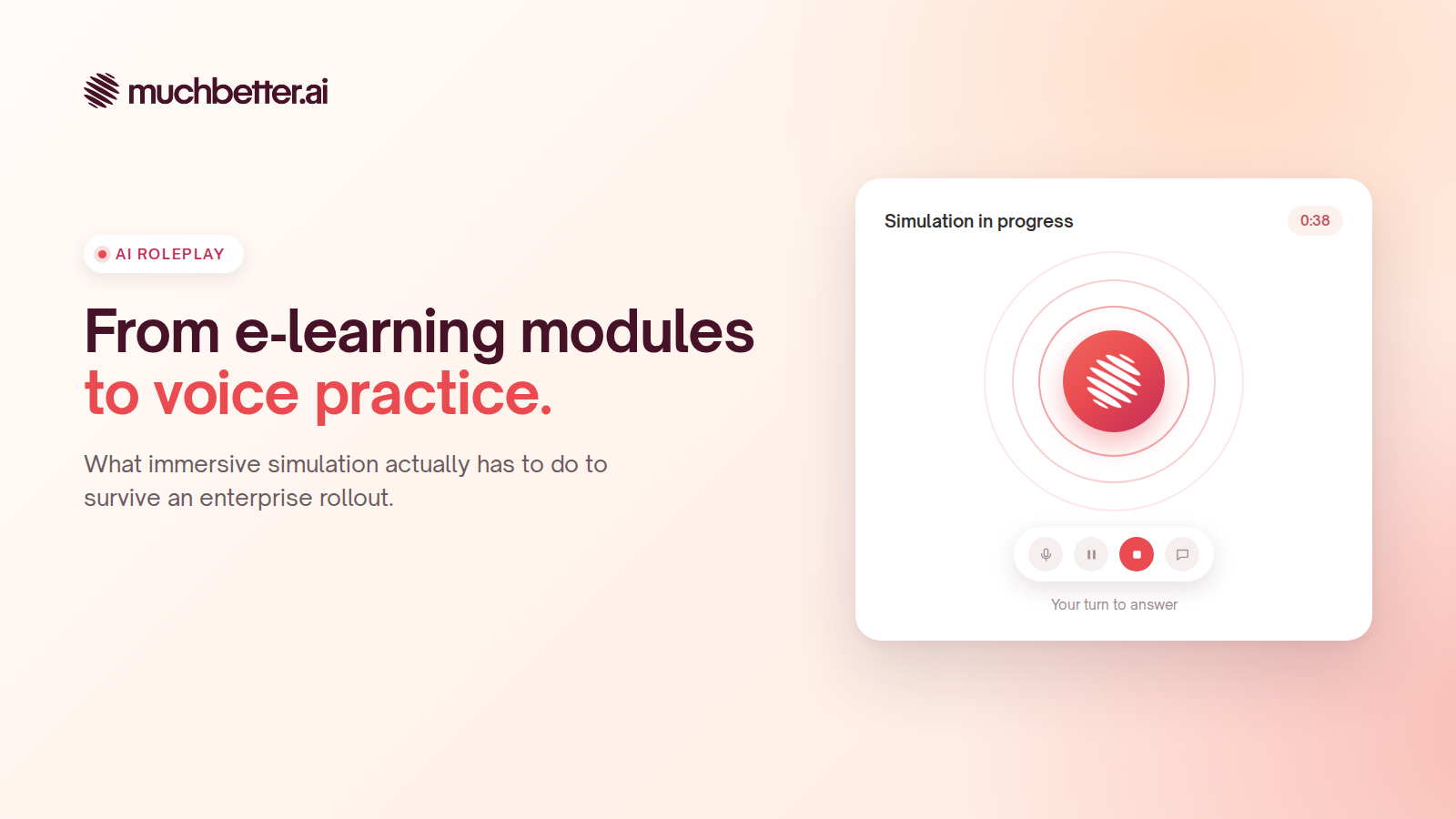
AI-powered sales simulations allow sales professionals to engage in realistic conversations with virtual customers that behave like real buyers.
These simulations can replicate:
Unlike static e-learning content, every interaction requires active participation.
Sales representatives must think, respond, adapt, and execute exactly as they would with a real customer.
Following each simulation, they receive detailed feedback on:
The result is a continuous cycle of practice, feedback, and reinforcement.
At muchbetter.ai, we help organizations transform sales enablement into measurable performance improvement.
Watch the demo below:

An AI sales training platform helps sales teams improve skills through guided practice, feedback, and repeatable training workflows. Instead of relying only on theory, reps can train with realistic scenarios, get coaching recommendations, and track progress over time. The goal is faster onboarding, stronger messaging, and better performance in real customer conversations.
Most AI sales training platforms combine structured learning paths with interactive practice. Reps train with scenarios (discovery, objections, demos), receive feedback on what to improve, and managers can monitor readiness with scorecards. The platform typically supports onboarding, continuous coaching, and certification gates to validate skills before reps go live.
It’s designed for sales leaders, enablement, and L&D teams who want consistent training at scale. It’s also useful for SDRs, AEs, and customer-facing teams that need to ramp quickly, practice messaging, and improve performance without depending solely on ad-hoc manager time.
AI sales training isn’t a replacement for managers, it’s a way to standardize and scale practice. Traditional training often focuses on content (slides, playbooks). An AI sales training platform adds structured repetition, feedback loops, and measurable progress, helping teams move from knowledge to real execution faster.
Common use cases include discovery calls, objection handling, qualification, negotiation, demo delivery, and follow-up messaging. Many teams also use AI training for onboarding, product updates, new pitch rollouts, and role-specific readiness (SDR vs AE). The best platforms support continuous improvement, not one-off workshops.
Yes. A strong AI sales training platform accelerates onboarding by giving reps clear weekly milestones, guided practice, and certification gates. This helps reduce time-to-first-meeting and time-to-first-opportunity, while giving managers visibility into readiness, so coaching is targeted instead of generic.
ROI is typically measured through ramp time reduction, improved conversion rates, higher win rates, shorter sales cycles, and better call quality. Many teams also track training completion, certification scores, and manager coaching hours saved. The most important metric is consistent performance improvement across the team, not just top reps.
No. It supports managers by automating practice routines and surfacing clear coaching signals. Managers stay focused on strategy, deal coaching, and real performance conversations, while the platform helps reps build skills through repeatable training and feedback between 1:1 sessions.
Look for realistic practice scenarios, clear feedback that reps can act on, manager dashboards, onboarding workflows, and easy content updates for messaging changes. Also check how the platform supports certification and continuous training, not just one-time sessions. Adoption is usually driven by simplicity and time-to-value.