Verwandeln Sie Vertriebskompetenz in messbare Ergebnisse
April 2, 2026

.png)

Publié
8/6/26
Ist der Einrichtungsprozess für unsere Teams zeitaufwändig?
Ganz und gar nicht. Der größte Teil des Designs und der Konfiguration wird vom Team muchbetter.ai übernommen. Ihr Beitrag beschränkt sich auf ein kurzes Kalibrierungsgespräch, in dem wir Schwerpunktbereiche und Szenarien definieren. Danach kümmern wir uns um den Rest.
Müssen wir unsere eigenen Simulationen erstellen oder aufzeichnen?
Nein. Unser Team entwirft die Simulationen auf der Grundlage Ihrer realen Kundensituationen. Sie validieren sie nur vor dem Start.
Wie viel Training benötigt unser Team, um die Plattform zu nutzen?
Praktisch keine. Die Benutzeroberfläche ist intuitiv und wir bieten bei Bedarf kurze Onboarding-Sitzungen an. Die meisten Benutzer beginnen innerhalb von Minuten mit dem Üben.
Wie hoch ist der Zeitaufwand für die Teilnehmer?
Jede Sitzung dauert etwa 30 Minuten, und die meisten Programme laufen 5—6 Sitzungen über 6—8 Wochen. Es lässt sich leicht in reguläre Arbeitszeitpläne integrieren.
Unterstützt uns muchbetter.ai nach dem Kickoff?
Absolut. Während des gesamten Programms überwacht unser Customer-Success-Team die Akzeptanz, berät die Manager und hilft Ihnen, die Wirkung zu messen. Du bist nie auf dich allein gestellt.
Welche Sprachen tun muchbetter.ai Unterstützung?
Wir unterstützen derzeit diese über 25 Sprachen und weitere auf Anfrage: Englisch, Spanisch, Französisch/Französisch-Kanadisch, Deutsch, Italienisch, Polnisch, Portugiesisch, Schwedisch, Rumänisch, Tschechisch, Dänisch, Niederländisch (NL), Chinesisch (Mandarin), Kantonesisch (HK), Vietnamesisch, Japanisch, Koreanisch, Hebräisch, Gujarati, Hindi, Indonesisch, Marathi, Tamilisch und Thailändisch.
Hat muchbetter.ai eine kostenlose Testversion anbieten?
Ja! Wir haben eine kostenlose interaktive Demo mit einer Vielzahl verschiedener vorgefertigter KI-Personas zur Verfügung. Um Ihre eigenen benutzerdefinierten KI-Simulationen zu erstellen, buchen Sie hier eine Demo.
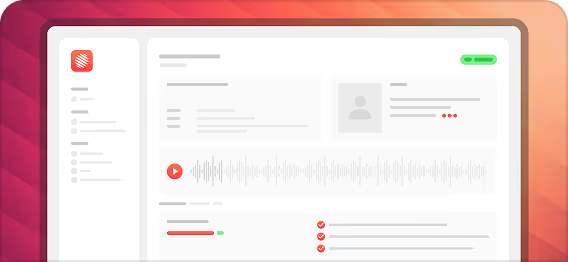
An AI sales training platform helps sales teams improve skills through guided practice, feedback, and repeatable training workflows. Instead of relying only on theory, reps can train with realistic scenarios, get coaching recommendations, and track progress over time. The goal is faster onboarding, stronger messaging, and better performance in real customer conversations.
Most AI sales training platforms combine structured learning paths with interactive practice. Reps train with scenarios (discovery, objections, demos), receive feedback on what to improve, and managers can monitor readiness with scorecards. The platform typically supports onboarding, continuous coaching, and certification gates to validate skills before reps go live.
It’s designed for sales leaders, enablement, and L&D teams who want consistent training at scale. It’s also useful for SDRs, AEs, and customer-facing teams that need to ramp quickly, practice messaging, and improve performance without depending solely on ad-hoc manager time.
AI sales training isn’t a replacement for managers, it’s a way to standardize and scale practice. Traditional training often focuses on content (slides, playbooks). An AI sales training platform adds structured repetition, feedback loops, and measurable progress, helping teams move from knowledge to real execution faster.
Common use cases include discovery calls, objection handling, qualification, negotiation, demo delivery, and follow-up messaging. Many teams also use AI training for onboarding, product updates, new pitch rollouts, and role-specific readiness (SDR vs AE). The best platforms support continuous improvement, not one-off workshops.
Yes. A strong AI sales training platform accelerates onboarding by giving reps clear weekly milestones, guided practice, and certification gates. This helps reduce time-to-first-meeting and time-to-first-opportunity, while giving managers visibility into readiness, so coaching is targeted instead of generic.
ROI is typically measured through ramp time reduction, improved conversion rates, higher win rates, shorter sales cycles, and better call quality. Many teams also track training completion, certification scores, and manager coaching hours saved. The most important metric is consistent performance improvement across the team, not just top reps.
No. It supports managers by automating practice routines and surfacing clear coaching signals. Managers stay focused on strategy, deal coaching, and real performance conversations, while the platform helps reps build skills through repeatable training and feedback between 1:1 sessions.
Look for realistic practice scenarios, clear feedback that reps can act on, manager dashboards, onboarding workflows, and easy content updates for messaging changes. Also check how the platform supports certification and continuous training, not just one-time sessions. Adoption is usually driven by simplicity and time-to-value.