Turn Sales Skills into Measurable Revenue Performance
April 2, 2026


Publié
29/9/26
We build one of these, so read what follows as a description of how the category works rather than a neutral survey. Our comparison of vendors, ourselves included, is a separate piece.
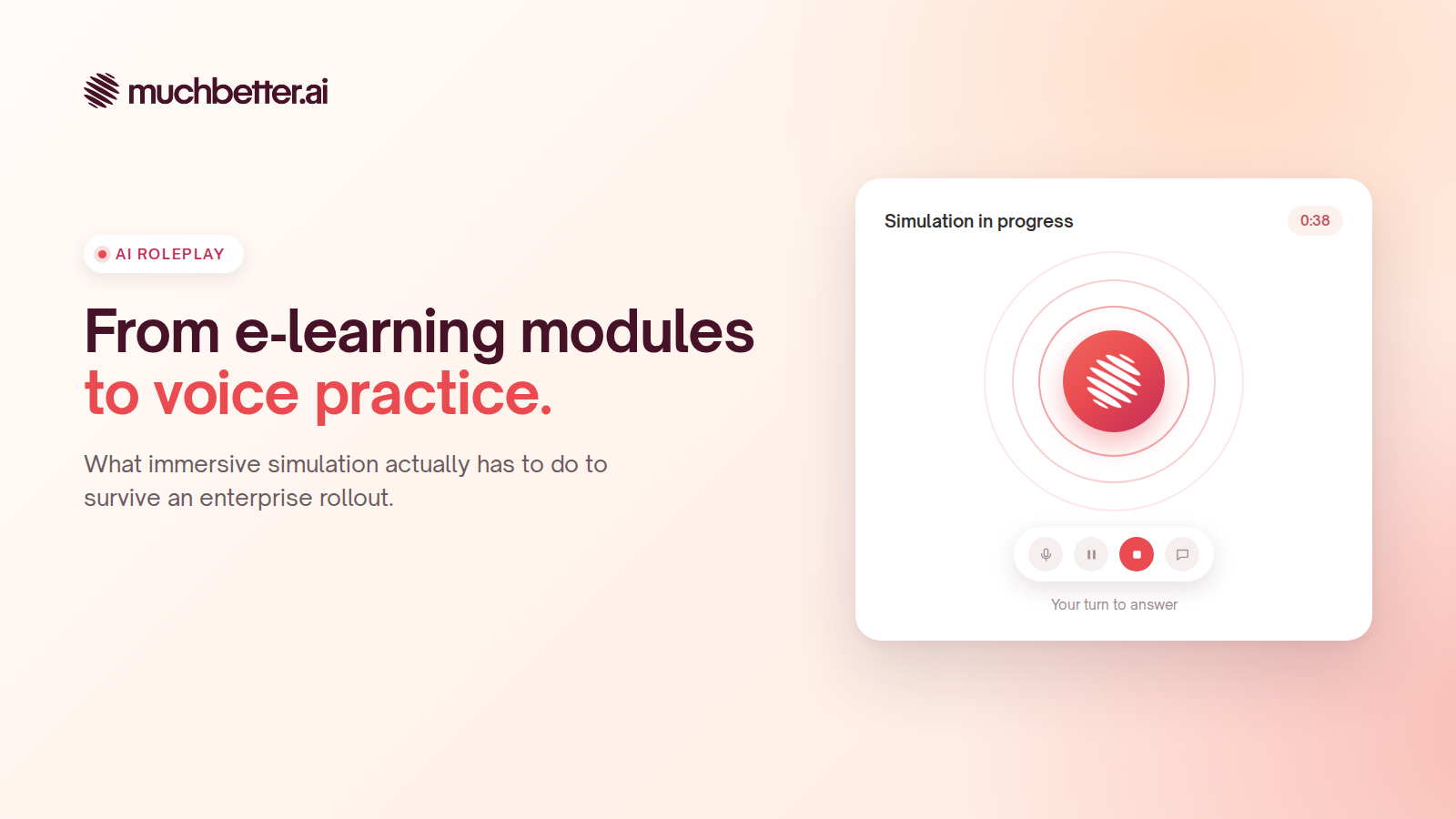
Most enterprise sales training still arrives as a module. A rep watches a sequence of slides or a talking head, answers four multiple-choice questions, and the LMS records a completion. Nothing in that sequence asks the rep to say anything out loud. The first time they speak the words, they are speaking them to a customer.
AI roleplay simulation platforms exist to close that gap. The interesting question is not whether simulated practice beats a module. It does, and the learning science on retrieval practice has said so for decades. The question is what a simulation platform has to do to survive contact with an enterprise rollout.
Text-based roleplay is cheaper to build and much easier to game. A rep can draft, delete and polish a written answer to a pricing objection in a way they will never manage on a live call. Voice simulation removes that margin. The answer has to arrive in the time a real buyer would wait for it, with the hesitation, the interruption and the silence that come with it.
That is also what makes the feedback usable. A voice exchange carries pace, filler, the length of the pause before the number, and whether the rep answered the question that was actually asked. None of that exists in a text exercise.
Peer roleplay works, when it happens. It usually does not. Practising an objection in front of colleagues is socially expensive, the manager plays the customer badly, and the sessions get cancelled the moment the quarter gets tight. Practitioners discussing AI roleplay keep returning to the same point: it removes the awkwardness of traditional role playing.
A simulated counterpart can be curt, distracted, better informed than the rep, or simply in a hurry. It can run the same objection eleven times until the answer stops being a recital and starts being a reflex. Nobody is watching, so the rep is free to be bad at it first.
Generic scenarios get abandoned in week three. Cold call a VP of Sales teaches nobody anything. The scenarios that hold attention are built from the products the team actually sells, the objections they actually hear and the buyers they actually meet. That is a content problem as much as a technical one, and it is the part that decides whether the platform is still in use in month six.
It is how teams at Schneider Electric, Bouygues Telecom, AXA and AG2R La Mondiale practise with us: voice personas built on their own products and their own objections, with automated feedback after every attempt.
Practice nobody can see is practice nobody manages. The enterprise requirement is a coaching dashboard: which reps have practised, on what, how a given skill has moved over eight weeks, and where a whole team is consistently weak. A weakness shared across a region is usually a messaging problem rather than a training one, and only aggregated practice data makes that visible.
Certification is the other half. A learning journey that ends in a scored, repeatable assessment gives an enablement lead something a completion rate never will: evidence that a named person could hold a specific conversation, on a specific date.
Sales practice sits inside an existing stack, not beside it. Native CRM integration lets scenarios inherit real accounts, real pipeline stages and real deal context instead of invented ones. LMS integration keeps the completion record where compliance and HR already look for it, so practice counts toward the same learning path as everything else.
Both matter more than they sound. A platform that cannot write back to the LMS becomes a second system managers have to remember to check, and it will lose that competition.
In insurance and banking the training obligation is measured in hours. In France, the IDD - the DDA - requires fifteen hours of continuing professional training a year from anyone distributing insurance. The regulation counts the hours. The duty it creates is a duty of advice, and that duty is discharged in a conversation: about a beneficiary clause, a risk profile, a product the client did not ask for.
That is the strongest argument for practice-based training in regulated sectors, and also the claim to scrutinise hardest when you buy. Ask any vendor exactly which certifications their assessment records satisfy, and what the compliance file looks like at the end of the year.
Voice, scenario provenance, manager visibility and stack integration are the four things that decide whether a simulation platform becomes part of how a sales team works, or another tab nobody opens. None of them is a question about the model. They are all questions about whether the practice is realistic enough to be uncomfortable, and visible enough to be managed.

An AI sales training platform helps sales teams improve skills through guided practice, feedback, and repeatable training workflows. Instead of relying only on theory, reps can train with realistic scenarios, get coaching recommendations, and track progress over time. The goal is faster onboarding, stronger messaging, and better performance in real customer conversations.
Most AI sales training platforms combine structured learning paths with interactive practice. Reps train with scenarios (discovery, objections, demos), receive feedback on what to improve, and managers can monitor readiness with scorecards. The platform typically supports onboarding, continuous coaching, and certification gates to validate skills before reps go live.
It’s designed for sales leaders, enablement, and L&D teams who want consistent training at scale. It’s also useful for SDRs, AEs, and customer-facing teams that need to ramp quickly, practice messaging, and improve performance without depending solely on ad-hoc manager time.
AI sales training isn’t a replacement for managers, it’s a way to standardize and scale practice. Traditional training often focuses on content (slides, playbooks). An AI sales training platform adds structured repetition, feedback loops, and measurable progress, helping teams move from knowledge to real execution faster.
Common use cases include discovery calls, objection handling, qualification, negotiation, demo delivery, and follow-up messaging. Many teams also use AI training for onboarding, product updates, new pitch rollouts, and role-specific readiness (SDR vs AE). The best platforms support continuous improvement, not one-off workshops.
Yes. A strong AI sales training platform accelerates onboarding by giving reps clear weekly milestones, guided practice, and certification gates. This helps reduce time-to-first-meeting and time-to-first-opportunity, while giving managers visibility into readiness, so coaching is targeted instead of generic.
ROI is typically measured through ramp time reduction, improved conversion rates, higher win rates, shorter sales cycles, and better call quality. Many teams also track training completion, certification scores, and manager coaching hours saved. The most important metric is consistent performance improvement across the team, not just top reps.
No. It supports managers by automating practice routines and surfacing clear coaching signals. Managers stay focused on strategy, deal coaching, and real performance conversations, while the platform helps reps build skills through repeatable training and feedback between 1:1 sessions.
Look for realistic practice scenarios, clear feedback that reps can act on, manager dashboards, onboarding workflows, and easy content updates for messaging changes. Also check how the platform supports certification and continuous training, not just one-time sessions. Adoption is usually driven by simplicity and time-to-value.