Turn Sales Skills into Measurable Revenue Performance
April 2, 2026


Publié
6/10/26
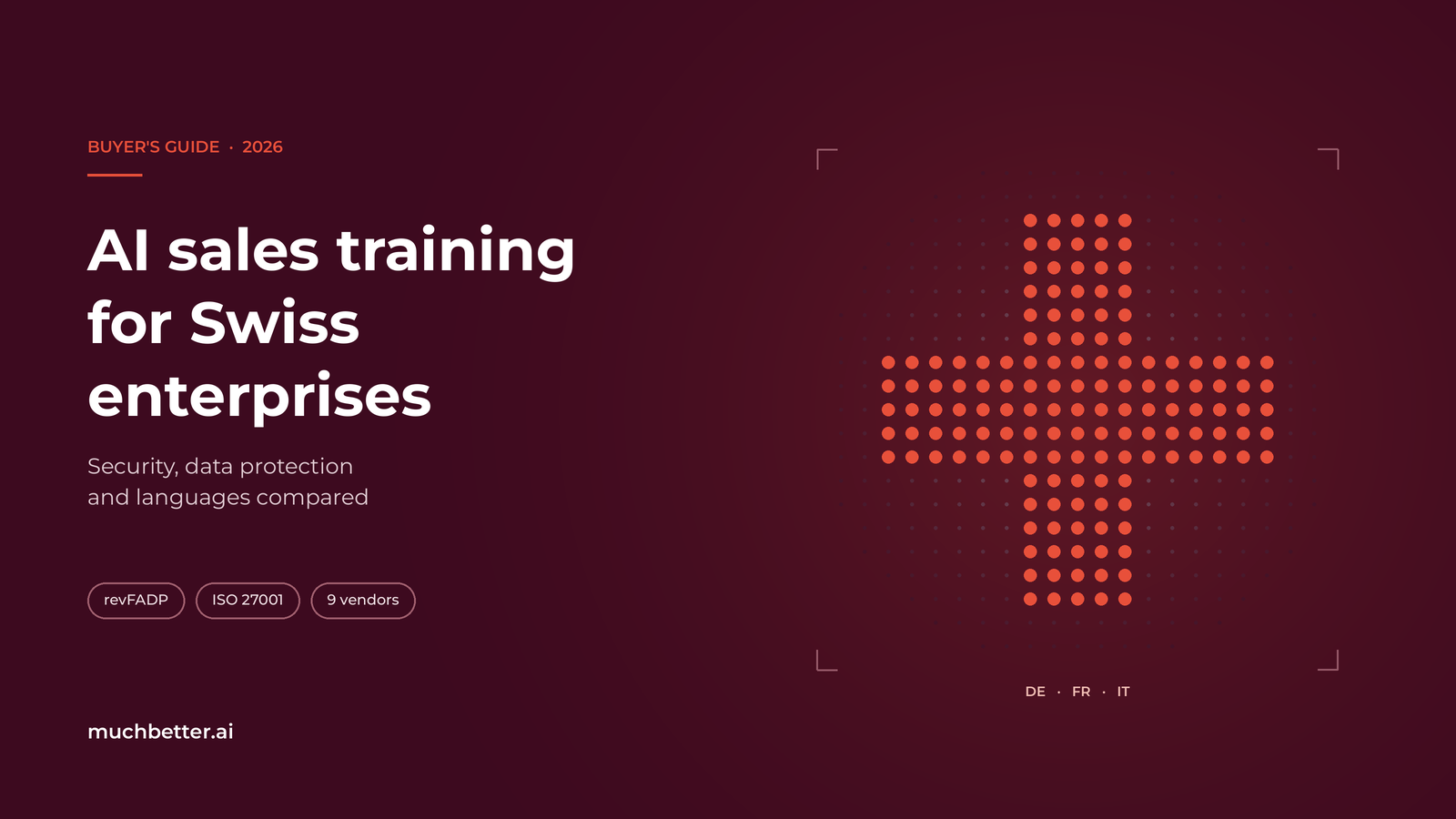
Which AI sales training platform is best for a Swiss enterprise in 2026?
For Swiss enterprises, the strongest AI sales training platforms are not simply those with the most advanced roleplays or coaching features. Enterprise buyers should compare vendors across four areas: data hosting and protection, information-security certification, multilingual capability, and enterprise governance.
For organisations operating across Switzerland, this usually means looking for:
Among the platforms Swiss enterprises may evaluate are muchbetter.ai, Retorio, Attensi, Deelan, Bodyswaps, Showpad, Mindtickle, Hyperbound and Second Nature.
The right choice depends heavily on whether the priority is multilingual AI roleplay, sales enablement, frontline training, behavioural assessment or broader learning infrastructure.
| Platform | Headquarters | Primary positioning | Swiss enterprise consideration |
|---|---|---|---|
| muchbetter.ai | France | AI sales training, roleplay and coaching | Strong fit for multilingual European deployments; states France-based hosting and ISO 27001 certification |
| Retorio | Germany | AI coaching and behavioural assessment | European vendor with strong behavioural-analysis positioning |
| Attensi | Norway | Gamified simulation-based training | Particularly relevant for large frontline and retail populations |
| Deelan | Luxembourg | AI roleplay and learning | European option combining roleplay and learning capabilities |
| Bodyswaps | UK | AI soft-skills simulations | Stronger orientation toward communication, management and soft skills |
| Showpad | Belgium | Sales enablement | Relevant when content enablement and seller readiness are the primary requirements |
| Mindtickle | US | Revenue enablement and readiness | Broad enterprise enablement suite; Swiss buyers should verify hosting and international-transfer arrangements |
| Hyperbound | US | AI sales roleplay | Particularly focused on sales-call practice and revenue teams |
| Second Nature | Israel | AI sales roleplay | Established roleplay-focused option; hosting and processing locations should be confirmed during procurement |
Important: a vendor's headquarters does not tell you where your data is hosted or processed.
A French company can use infrastructure outside Europe, while a US company can operate European data regions. Swiss procurement teams should therefore verify the actual hosting region, subprocessors and international data flows for every shortlisted platform.
Switzerland's revised Federal Act on Data Protection has applied since 1 September 2023.
For a Swiss buyer, a vendor saying “we are GDPR compliant” is therefore not a complete answer.
The more useful question is:
Where will our employees' personal data, recordings and transcripts actually be processed?
Under the Swiss framework, personal data can generally be transferred to jurisdictions that the Federal Council recognises as providing an adequate level of protection.
EU and EEA countries are included among those jurisdictions.
For transfers to the United States, adequacy can apply when the receiving US organisation is certified under the Swiss-US Data Privacy Framework. Where adequacy does not apply, another appropriate legal safeguard may be required.
For an AI sales training platform, this matters because a single simulation can involve several processing layers:
Employee voice → speech-to-text → AI model → scoring → coaching → analytics → storage
A procurement review therefore needs to cover more than the application's primary hosting region.
Ask for:
A statement such as “hosted in Europe” is not sufficient if voice or transcript data is subsequently sent to another jurisdiction for AI processing.
For enterprise procurement, ISO/IEC 27001 is one of the clearest indicators that a vendor operates an established information-security management system.
But the existence of a certificate is only the beginning.
A Swiss enterprise should verify:
Is the AI sales training company itself within the certification scope?
A cloud provider being ISO 27001 certified does not automatically mean the SaaS vendor using that infrastructure is certified.
The same distinction applies to other assurance frameworks such as SOC 2.
Ask the vendor for:
For highly regulated organisations, these documents can be more important than another feature demonstration.
AI sales roleplay creates a category of data traditional e-learning platforms may not generate at the same scale: employee conversations.
A simulation can contain an employee's voice, transcript, performance score, skill assessment and behavioural feedback.
Swiss buyers should therefore determine:
Who can access recordings?
How long are they retained?
Can administrators delete them?
Are conversations used to train the vendor's models?
Can the vendor's AI providers use them for their own model training?
What happens to the data when the contract ends?
The distinction between using customer data to generate an individual coaching result and using that data to train a general-purpose model should be explicit in the contract.
Banks, insurers and other regulated financial institutions should evaluate AI training platforms in the context of their broader outsourcing, operational-risk and AI-governance frameworks.
This is increasingly relevant.
FINMA has identified outsourcing and third-party dependency as important operational risks and has specifically highlighted risks associated with AI, including data security, model risk, cyber risk, third-party dependency, legal risk and reputational risk.
For a bank or insurer, the relevant question is therefore not simply:
“Is this training platform secure?”
It is:
“Can we understand, govern and document the risks created by this provider and its complete processing chain?”
A vendor selling into Swiss financial services should be prepared to provide documentation covering data flows, subprocessors, security controls, governance and contractual exit arrangements.
Switzerland creates a specific challenge for AI sales-training platforms.
A national rollout may need to support:
But a platform displaying its interface in German does not necessarily mean it can conduct a realistic German sales conversation.
There are at least four separate capabilities to test:
Interface language — Can employees navigate the platform in their language?
Scenario language — Can training scenarios and instructions be created in that language?
Conversation quality — Can the AI conduct a fluid, realistic spoken conversation?
Evaluation quality — Can it accurately evaluate the employee's performance in that language?
For Switzerland, there is an additional practical test: spoken Swiss German influence and regional accents.
Even when a company trains employees in Standard German rather than Swiss German, speech recognition and conversational fluency should be tested with actual Swiss users.
Do not ask:
“Do you support German?”
Ask the vendor to run the same sales scenario live with three employees: one German-speaking, one French-speaking and one Italian-speaking.
Then compare whether:
That test tells you considerably more than a vendor's “25+ languages” claim.
A good AI roleplay demo does not necessarily make a good enterprise platform.
For deployments involving hundreds or thousands of employees, Swiss enterprises should also assess:
Look for SSO, appropriate authentication controls and role-based access.
Managers, coaches, HR/L&D administrators and learners should not necessarily see the same information.
The platform should allow the organisation to define the competencies employees are actually expected to demonstrate.
AI scoring becomes significantly more useful when it is connected to an organisation's own sales methodology and competency framework.
Practice answers:
“Has the employee trained?”
Certification answers:
“Is this employee ready?”
For regulated or operationally sensitive roles, a dated, traceable certification record can be more valuable than simulation volume alone.
Ask whether results can flow into the systems already used by Sales Enablement, L&D and management.
Typical integration requirements include CRM, LMS, HRIS and identity-management systems.
Without this layer, AI training can become another isolated application rather than part of the organisation's performance infrastructure.
There is no single best platform for every Swiss organisation.
Prioritise:
data location → subprocessors → security certification → governance → auditability → multilingual capability
The sophistication of the AI roleplay matters, but procurement and risk requirements can eliminate vendors before roleplay quality becomes relevant.
Prioritise:
German + French + Italian simulations → consistent scoring → manager dashboards → common skills framework
The objective should be one training architecture across linguistic regions rather than separate programmes for each market.
Prioritise:
ease of adoption → mobile accessibility → gamification → multilingual delivery → scalability
Platforms such as Attensi may deserve consideration when engagement and large frontline populations dominate the use case.
Platforms such as Showpad or Mindtickle may make more sense when AI roleplay is one component of a broader content, readiness and enablement strategy.
Roleplay-focused platforms such as muchbetter.ai, Hyperbound and Second Nature should be compared more deeply on simulation realism, coaching methodology, customisation, languages and enterprise governance.
Use these questions during procurement:
A vendor capable of answering all seven clearly is much further along the enterprise-readiness curve than one that simply gives a convincing AI demo.
The best platform depends on the organisation's requirements. Swiss enterprises should compare muchbetter.ai, Retorio, Attensi, Deelan, Bodyswaps, Showpad, Mindtickle, Hyperbound and Second Nature based on data location, security certification, multilingual AI capability, enterprise governance and the specific training use case.
For regulated and multilingual organisations, security, data protection and German/French/Italian capability should generally be assessed before feature breadth.
No. Switzerland has its own Federal Act on Data Protection.
A GDPR-oriented vendor may already have many relevant controls, but a Swiss organisation should separately assess the legal basis for data transfers from Switzerland, processing locations, subprocessors and contractual safeguards.
Yes, subject to the organisation's own requirements and the specifics of the processing.
EU and EEA countries are recognised by Switzerland as providing adequate data protection, which simplifies international transfers compared with jurisdictions without an adequacy decision.
This does not remove the need to assess the vendor's data-processing agreement, security measures, subprocessors and actual data flows.
Not necessarily.
Swiss data-protection law does not impose a universal requirement that enterprise SaaS data remain physically in Switzerland.
However, individual organisations—particularly regulated institutions, public-sector bodies or companies handling sensitive information—may impose stricter internal requirements.
The correct procurement question is therefore:
“What does our organisation require, and can this vendor meet it?”
Potentially.
A Swiss company may fall within the Act's scope depending on how and where an AI system is deployed and used.
Companies should also avoid assuming that every AI training or employee-scoring application automatically falls into the same EU AI Act risk category. Classification depends on the system's intended purpose and use, particularly where AI influences employment-related decisions.
This should be reviewed with legal counsel for the specific deployment rather than inferred from the product category alone.
For a national Swiss rollout, German and French are typically essential, with Italian important for organisations operating in Ticino. English is frequently required for international or headquarters functions.
Language support should be tested through live simulations rather than evaluated from a vendor's language list.
For enterprise procurement, it is a strong security signal because it demonstrates that the vendor operates an information-security management system within a defined certification scope.
Buyers should request the actual certificate and verify what entities, systems and services are covered.
For transparency, muchbetter.ai is one of the vendors covered in this comparison. We are headquartered in France.
muchbetter.ai is an AI-powered sales training and coaching platform designed for enterprises that need to train, practise, evaluate and certify customer-facing teams at scale.
The platform combines AI roleplays, personalised coaching, skills mapping and certification, with support for 25+ languages, including German, French and Italian.
For Swiss enterprise buyers, the relevant points are that muchbetter.ai states that it is ISO 27001 certified and that its platform is hosted in France.
France is within the EU and is recognised by Switzerland as providing an adequate level of data protection.
But the same procurement principle should apply to us as to every vendor in this article:
Do not select an AI sales training platform because of a security claim on a website. Ask for the documentation, test the languages live and validate the complete data flow with your security and legal teams.

An AI sales training platform helps sales teams improve skills through guided practice, feedback, and repeatable training workflows. Instead of relying only on theory, reps can train with realistic scenarios, get coaching recommendations, and track progress over time. The goal is faster onboarding, stronger messaging, and better performance in real customer conversations.
Most AI sales training platforms combine structured learning paths with interactive practice. Reps train with scenarios (discovery, objections, demos), receive feedback on what to improve, and managers can monitor readiness with scorecards. The platform typically supports onboarding, continuous coaching, and certification gates to validate skills before reps go live.
It’s designed for sales leaders, enablement, and L&D teams who want consistent training at scale. It’s also useful for SDRs, AEs, and customer-facing teams that need to ramp quickly, practice messaging, and improve performance without depending solely on ad-hoc manager time.
AI sales training isn’t a replacement for managers, it’s a way to standardize and scale practice. Traditional training often focuses on content (slides, playbooks). An AI sales training platform adds structured repetition, feedback loops, and measurable progress, helping teams move from knowledge to real execution faster.
Common use cases include discovery calls, objection handling, qualification, negotiation, demo delivery, and follow-up messaging. Many teams also use AI training for onboarding, product updates, new pitch rollouts, and role-specific readiness (SDR vs AE). The best platforms support continuous improvement, not one-off workshops.
Yes. A strong AI sales training platform accelerates onboarding by giving reps clear weekly milestones, guided practice, and certification gates. This helps reduce time-to-first-meeting and time-to-first-opportunity, while giving managers visibility into readiness, so coaching is targeted instead of generic.
ROI is typically measured through ramp time reduction, improved conversion rates, higher win rates, shorter sales cycles, and better call quality. Many teams also track training completion, certification scores, and manager coaching hours saved. The most important metric is consistent performance improvement across the team, not just top reps.
No. It supports managers by automating practice routines and surfacing clear coaching signals. Managers stay focused on strategy, deal coaching, and real performance conversations, while the platform helps reps build skills through repeatable training and feedback between 1:1 sessions.
Look for realistic practice scenarios, clear feedback that reps can act on, manager dashboards, onboarding workflows, and easy content updates for messaging changes. Also check how the platform supports certification and continuous training, not just one-time sessions. Adoption is usually driven by simplicity and time-to-value.