Turn Sales Skills into Measurable Revenue Performance
April 2, 2026


Publié
11/9/26
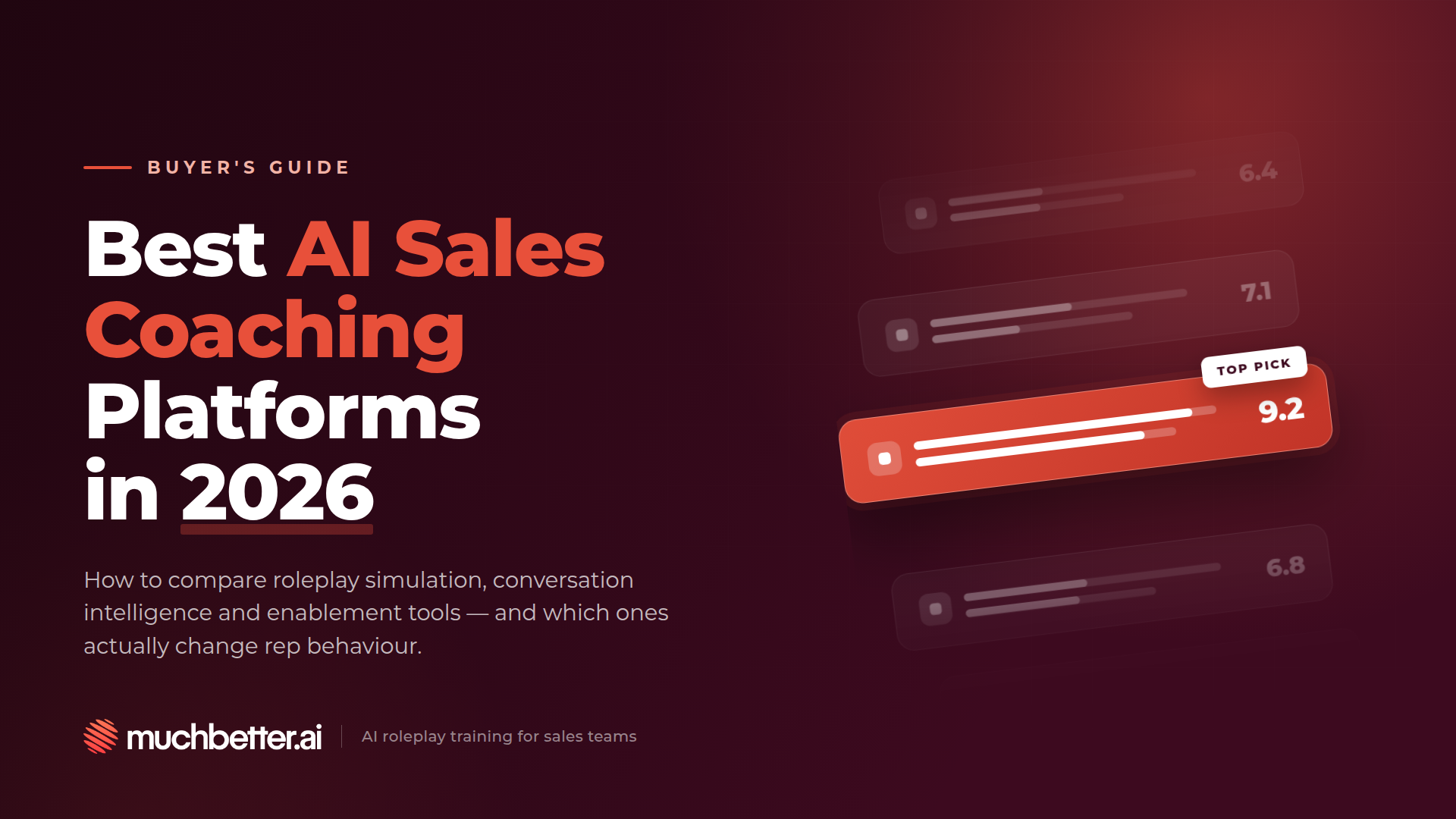
We build one of these. That is worth knowing before you read a word of what follows, and it is why this guide is structured as criteria first and vendors second - so you can apply the framework and reach a different conclusion than we would.
The category has crowded fast. Two years ago the choice was between a handful of conversation-intelligence tools and traditional training providers. In 2026 there are at least twenty platforms offering some form of AI sales roleplay, and almost every published ranking is written by one of them. The useful question is not which AI sales roleplay platform is best. It is which one fits the shape of your problem.
Read the seven criteria first and decide which three matter for your rollout. Then read the comparison table and the vendor notes with those three in mind. The shortlist-by-situation section at the end maps five common buying situations to the criteria that should carry the most weight.
Vendor descriptions reflect how each company positions itself publicly as of September 2026. We have not run controlled benchmarks against competitors and we would not ask you to trust ours if we had. Verify current capabilities on a demo - this category ships fast and any guide is a snapshot.
Text roleplay is cheaper to build and much easier to game. A rep can draft, delete and polish a written objection response in a way they will never be able to do on a live call. If your reps sell by speaking, they need to practise by speaking, under the time pressure of a real conversation - with interruptions, hesitation and a counterpart who does not wait politely for them to finish.
How to test it: ask the vendor to let you interrupt the AI mid-sentence. A text engine with speech bolted on will handle that badly.
Generic scenarios get abandoned in week three. Cold call a VP of Sales teaches nobody anything. Ask whether simulations can be built from your real products, your real objections, your real buyer personas and, ideally, live CRM data - and how long that build takes when it is your team doing it rather than the vendor's onboarding consultant.
How to test it: hand over a product sheet on the demo and ask them to build a scenario from it while you watch.
Good job, 7/10 is not coaching. Useful feedback names the moment and the behaviour: you answered the pricing objection before you understood what was driving it; you never confirmed the impact of the problem the buyer described. Ask what skills framework the platform scores against, whether you can replace it with your own methodology, and what a manager actually sees on a Monday morning.
How to test it: ask for a score broken into at least three axes rather than one composite number. A single score hides which skill is failing.
Practice without a gate is optional, and optional training does not survive a busy quarter. Certification is what turns practice into a readiness decision - this rep is cleared to run the conversation, that one is not yet. It is also what makes the programme defensible to an auditor in a regulated sector.
How to test it: ask whether the platform records a completion date or a traceable skill record you could open during a one-to-one or an audit.
Many platforms claim multilingual and deliver an English model with a translated interface. The AI counterpart's idiom, objections and cultural register matter as much as the words. If your Madrid team practises against a Spanish-speaking American buyer persona, you have built a translation exercise, not a sales simulation.
How to test it: ask for a live simulation in the language your team actually sells in, not a recording.
For regulated industries this decides the shortlist before features do. ISO 27001 certification, GDPR compliance, where the data is physically hosted, who can access conversation recordings, how long they are retained, and how the platform sits against the EU AI Act. European enterprises in banking, insurance and health increasingly cannot deploy a US-hosted training platform regardless of how good the product is.
How to test it: ask for the certification, the hosting region and the retention policy in writing before the second meeting.
Whether results flow into your CRM, LMS and HR systems, or whether someone exports a spreadsheet every month. This is the criterion buyers underweight at signature and regret at month six, because it determines whether training data ever reaches the people making promotion, coaching and territory decisions.
How to test it: ask to see the integration running with a real customer's stack, not a slide.
| Platform | Headquarters | Primary shape | Best fit when |
|---|---|---|---|
| muchbetter.ai | France | Voice-first roleplay, coaching and certification | Multi-country enterprise rollout in a regulated sector, European hosting required |
| Hyperbound | San Francisco, US | AI roleplay tied to pipeline outcomes | SDR and AE call practice measured against revenue metrics |
| Second Nature | Tel Aviv, Israel | Roleplay-first training software | You want a mature roleplay product with a large existing enterprise footprint |
| Mindtickle | San Francisco, US | Enablement suite with roleplay as a module | You are buying a full enablement platform and want roleplay inside it |
| Quantified | Austin, US | AI coaching with a life sciences focus | You sell in life sciences and need that vertical's compliance vocabulary |
| Yoodli | Seattle, US | Communication and speaking coaching | The gap is delivery and confidence more than product mastery |
| Retorio | Munich, Germany | Behavioural analysis plus coaching | You want behavioural assessment alongside conversation practice |
| Attensi | Oslo, Norway | Gamified simulation training | Frontline and retail populations where engagement mechanics carry the programme |
| Deelan | Luxembourg | Roleplay combined with an LMS | You need training delivery and roleplay from one European vendor |
| Bodyswaps | London, UK | Immersive soft-skills simulation, including VR | Soft skills and management training as much as sales |
| Seismic (incl. Highspot) | San Diego, US | Revenue enablement platform with training modules | Content management and buyer engagement are the primary need |
| Showpad | Ghent, Belgium | Sales enablement with coaching modules | Content enablement first, coaching second, European vendor preferred |
This is not a ranking. The right-hand column is the only one that should decide anything.
AI sales roleplay is practice against a simulated buyer. A rep holds a conversation - usually by voice - with an AI counterpart playing a specific persona in a specific situation: a procurement director pushing back on price, a sceptical clinician, a customer whose contract is up for renewal. The platform then scores the conversation against a skills framework and returns feedback tied to specific moments. The point is repetition before the real call, not replacing the real call.
It improves the things practice improves: objection handling, discovery discipline, talk-to-listen ratio, confidence in the first ninety seconds. Across our own enterprise deployments we have seen ramp time cut by 30-50% and measurable gains in discovery and objection handling - Philips recorded +45% on technical objections, AG2R La Mondiale +57% on needs discovery, Bouygues Telecom +36% on discovery. Those are our customers' numbers from our own programmes, so read them as evidence that the mechanism works rather than as an industry benchmark. Ask every vendor for equivalents and ask how they were measured.
Yes, if your reps sell on the phone or face to face. Text lets a rep compose and revise; a live conversation does not. The skills that fail under pressure are pace, interruption recovery and thinking on your feet, and none of them are exercised by typing.
Pricing in this category is almost always per user per year with a platform fee, and almost never published. Expect the enterprise platforms in this guide to price on seats, number of scenarios and depth of integration. The variables that move the number most are the size of the population, whether certification is included, and how much scenario authoring the vendor does for you rather than your team doing it.
For an individual rep practising alone, a general-purpose assistant with a good prompt works, and plenty of people will tell you exactly that. It stops working when you need consistency across two hundred reps, a scoring framework your managers trust, an audit trail, and a way to know who is ready. That is the line between a personal habit and a training programme.
Where conversation recordings are hosted and for how long, who inside the vendor can access them, whether the model is trained on your conversations, and how the vendor classifies the system under the AI Act. For sales training the risk classification is usually low, but employment-adjacent scoring deserves a direct question rather than an assumption.
muchbetter.ai is built for the first four situations in the shortlist above and for the fifth least of all. It is a voice-first AI sales training and coaching platform with 490+ AI counterparts, adaptive coaching, skills mapping and certification, in 25+ languages, ISO 27001 certified and hosted in France. More than 400,000 simulations have been run on it by over 45,000 active users.
It is used by Schneider Electric, Philips, AXA, BNP Paribas Personal Finance, La Poste, Bouygues Telecom, AG2R La Mondiale, Boulanger, UFF, Asten Sante, Paritel and Concentrix. If your rollout is a small team wanting to self-serve by Friday, one of the lighter tools above will serve you better, and we would rather tell you that here than on the third call.

An AI sales training platform helps sales teams improve skills through guided practice, feedback, and repeatable training workflows. Instead of relying only on theory, reps can train with realistic scenarios, get coaching recommendations, and track progress over time. The goal is faster onboarding, stronger messaging, and better performance in real customer conversations.
Most AI sales training platforms combine structured learning paths with interactive practice. Reps train with scenarios (discovery, objections, demos), receive feedback on what to improve, and managers can monitor readiness with scorecards. The platform typically supports onboarding, continuous coaching, and certification gates to validate skills before reps go live.
It’s designed for sales leaders, enablement, and L&D teams who want consistent training at scale. It’s also useful for SDRs, AEs, and customer-facing teams that need to ramp quickly, practice messaging, and improve performance without depending solely on ad-hoc manager time.
AI sales training isn’t a replacement for managers, it’s a way to standardize and scale practice. Traditional training often focuses on content (slides, playbooks). An AI sales training platform adds structured repetition, feedback loops, and measurable progress, helping teams move from knowledge to real execution faster.
Common use cases include discovery calls, objection handling, qualification, negotiation, demo delivery, and follow-up messaging. Many teams also use AI training for onboarding, product updates, new pitch rollouts, and role-specific readiness (SDR vs AE). The best platforms support continuous improvement, not one-off workshops.
Yes. A strong AI sales training platform accelerates onboarding by giving reps clear weekly milestones, guided practice, and certification gates. This helps reduce time-to-first-meeting and time-to-first-opportunity, while giving managers visibility into readiness, so coaching is targeted instead of generic.
ROI is typically measured through ramp time reduction, improved conversion rates, higher win rates, shorter sales cycles, and better call quality. Many teams also track training completion, certification scores, and manager coaching hours saved. The most important metric is consistent performance improvement across the team, not just top reps.
No. It supports managers by automating practice routines and surfacing clear coaching signals. Managers stay focused on strategy, deal coaching, and real performance conversations, while the platform helps reps build skills through repeatable training and feedback between 1:1 sessions.
Look for realistic practice scenarios, clear feedback that reps can act on, manager dashboards, onboarding workflows, and easy content updates for messaging changes. Also check how the platform supports certification and continuous training, not just one-time sessions. Adoption is usually driven by simplicity and time-to-value.