Turn Sales Skills into Measurable Revenue Performance
April 2, 2026

.png)

Publié
10/9/26
We have all experienced that dreaded moment: your palms are sweaty, your heart is racing, and you are about to start a high-stakes conversation. Historically, professionals learned by trial and fire on actual clients, which carries massive financial and reputational risk. Today, overcoming cold calling anxiety with technology is changing how we prepare for these critical moments.
Rather than nervously rehearsing in front of a bathroom mirror, imagine stepping into a flight simulator designed entirely for business communication. According to training experts, an AI sales simulation allows you to crash and burn without any real-world consequences. This creates a digital safety net where you can test out different responses to angry customers or tricky pricing questions without losing a deal.
Having a dedicated practice partner available around the clock transforms this learning process into a true safe space. In practice, running through a difficult scenario ten times before the actual meeting completely changes the outcome. You walk into the real room with quiet confidence, knowing you have already navigated every possible objection a digital actor could throw your way.

Pitching a new idea or selling a product often triggers an anxious knot in the stomach. Traditional preparation involves forcing a coworker to listen, which feels awkward and unnatural. A true judgment-free zone changes this dynamic entirely, offering a private safe space where mistakes become stepping stones to building confidence.
Instead of talking to a wall, imagine interacting with a digital actor. Unlike frustrating customer service chatbots that only understand simple commands, a reactive AI persona actually listens and responds to the nuance of your argument. It utilizes generative AI for business communication training to stay perfectly in character. If you act too pushy, the digital customer might pull back; if you clearly explain the value, they become genuinely interested.
Every practice session becomes completely unique because the system relies on realistic sales scenario modeling tailored to your specific choices. You get the authentic feel of a high-stakes conversation, but without the risk of losing an actual client. When you compare this dynamic, private rehearsal space to practicing with a busy manager, it quickly becomes clear why traditional roleplay fails and how digital scenarios fix it.
Sitting across from a colleague to practice a pitch is a familiar, often dreaded office ritual. When comparing traditional roleplay vs digital simulations, pretending your desk-mate is a tough customer rarely feels realistic. They already know your product and your habits, making the entire interaction feel artificial rather than authentic.
This discomfort isn’t just in your head. Human-to-human roleplay typically falls flat for four specific reasons:
A digital practice partner completely flips this frustrating dynamic. These tools serve as scalable sales team training solutions because they are accessible 24/7 for just-in-time rehearsal. Instead of waiting weeks for a scheduled workshop, you can warm up exactly ten minutes before a crucial call. Furthermore, this system relies on absolute feedback consistency, replacing the subjective opinions of busy colleagues with clear, objective observations.
Genuine confidence requires a space where you can stumble without an audience. By removing the bias and embarrassment inherent in peer exercises, you build a much stronger foundation for measurable growth. Once that safe, private environment is established, the focus shifts entirely to your performance and how real-time feedback sharpens your pitch.
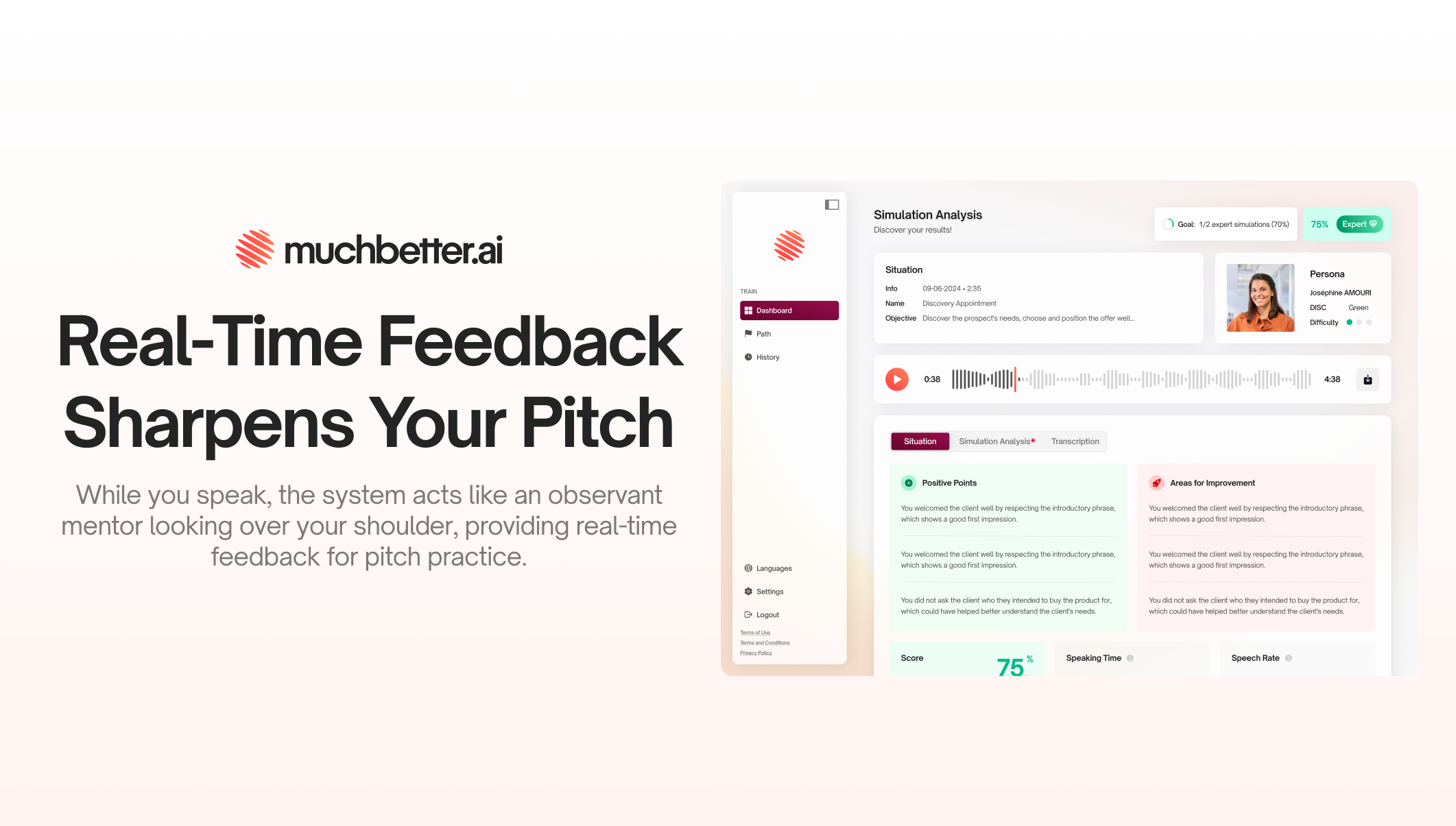
Once inside this private practice room, the true magic of a digital coach reveals itself. While you speak, the system acts like an observant mentor looking over your shoulder, providing real-time feedback for pitch practice. It listens carefully to your delivery, noticing if you rush through your product explanation or if your voice wavers when a customer asks a difficult question about pricing.
The emotional temperature of a conversation is just as crucial as remembering your script. That is where a feature often called sentiment analysis comes in, functioning as an advanced tone-reader. By utilizing this conversational intelligence for sales training, the simulator detects whether your digital customer sounds frustrated or engaged, helping you practice how to adjust your energy to build genuine rapport.
Guesswork completely disappears the moment you finish your session. You immediately receive a digital scorecard that breaks down your pacing, clarity, and how often you used key phrases. This data-driven sales skill assessment allows you to track your daily progress, pinpointing exactly where you are improving and which specific objections still cause you to stumble.
Consistent tracking turns nervous beginners into confident professionals. When you can literally see your communication skills sharpening day by day on a simple dashboard, the overwhelming learning curve shrinks dramatically. It is exactly this rapid, focused improvement cycle that ultimately leads to cutting onboarding time in half.
Starting a new job usually involves staring at training manuals, hoping the information simply sticks. But the leap from reading a binder to speaking with a living customer is terrifying. This learning curve dictates a new employee's ramp time—the weeks it takes them to reach full productivity. Instead of leaving beginners to learn through awkward trial and error on live calls, AI practice partners bridge this gap. By replacing passive reading with simulated, realistic conversations, businesses are discovering exactly how to reduce sales onboarding ramp time.
Imagine the financial impact of getting a new team member capable and confident a month earlier than expected. Achieving a significant reduction in training time is precisely why measuring the ROI of sales training technology now focuses on rapid success rather than hours logged in a classroom. This approach also creates scalable onboarding. Whether a business is hiring ten people or one hundred simultaneously, every single employee gets a dedicated digital coach without burning out human managers.
Moving from textbook theory to personalized digital roleplay is among the most exciting sales enablement technology trends today. Because these virtual scenarios adapt to individual weaknesses, trainees can repeatedly practice the exact conversations that make them nervous. Once that foundational confidence is built, they are fully prepared for the hardest part of any deal.
Hearing a customer suddenly shut down a conversation can make even the most prepared person freeze up. Instead of fumbling through these high-stakes moments in real life, professionals are turning to AI sales coaching. By facing a difficult digital customer first, you safely experience that initial sting of rejection and learn exactly how to pivot.
Think of this process like a musician practicing a scale until their fingers move automatically. When using automated sales coaching platforms, you actually build muscle memory for your speech. The simulation pushes back just like a real human would, allowing you to develop the ability to stay calm under digital pressure. Because there is no real-world penalty for making a mistake, you can try out different responses until your words flow effortlessly.
Repeatedly facing these specific scenarios helps you build a valuable mental library of confident responses for the toughest questions. You can program the practice partner to throw distinct hurdles your way, directly refining your logic and persuasion. In just one afternoon, you can comfortably practice handling:
Mastering these moments turns a terrifying roadblock into a manageable step in the process. Improving objection handling with machine learning means you never have to guess how someone might react because you have already navigated the interaction.
By implementing a digital sales lab, you create a personalized practice routine to maintain and sharpen your skills. Simply try a scenario with your AI partner, review your feedback scorecard without fear of judgment, and repeat the process. Each session transforms professional communication from a source of stress into a source of strength.
Recognize this technology as a supportive partner rather than a replacement for human intuition. As you incorporate AI sales training into your professional development, remember that consistent practice builds more than just conversational skill. It builds the lasting, authentic confidence you need to succeed in any high-stakes environment.
AI sales simulation is an immersive training environment where sales reps interact with realistic virtual customers. It allows them to practice high-stakes scenarios (objections, negotiation, discovery) without real-world risk, with instant and objective feedback.
Unlike peer roleplay, AI simulation provides:
The result: more repetition, less bias, and measurable improvement.
Yes. AI simulations use advanced conversational models that react to tone, structure, and intent. Each interaction evolves dynamically based on the user’s responses, closely mimicking real customer conversations.
Absolutely. Each session generates detailed metrics such as clarity, pace, structure, and objection handling. These insights make progress visible and actionable.
Yes—this is one of the most impactful use cases. New hires can practice intensively before speaking to real customers, significantly reducing ramp-up time.
No. It enhances them. AI handles repetition and analysis, allowing managers to focus on high-value coaching and strategic development.

An AI sales training platform helps sales teams improve skills through guided practice, feedback, and repeatable training workflows. Instead of relying only on theory, reps can train with realistic scenarios, get coaching recommendations, and track progress over time. The goal is faster onboarding, stronger messaging, and better performance in real customer conversations.
Most AI sales training platforms combine structured learning paths with interactive practice. Reps train with scenarios (discovery, objections, demos), receive feedback on what to improve, and managers can monitor readiness with scorecards. The platform typically supports onboarding, continuous coaching, and certification gates to validate skills before reps go live.
It’s designed for sales leaders, enablement, and L&D teams who want consistent training at scale. It’s also useful for SDRs, AEs, and customer-facing teams that need to ramp quickly, practice messaging, and improve performance without depending solely on ad-hoc manager time.
AI sales training isn’t a replacement for managers, it’s a way to standardize and scale practice. Traditional training often focuses on content (slides, playbooks). An AI sales training platform adds structured repetition, feedback loops, and measurable progress, helping teams move from knowledge to real execution faster.
Common use cases include discovery calls, objection handling, qualification, negotiation, demo delivery, and follow-up messaging. Many teams also use AI training for onboarding, product updates, new pitch rollouts, and role-specific readiness (SDR vs AE). The best platforms support continuous improvement, not one-off workshops.
Yes. A strong AI sales training platform accelerates onboarding by giving reps clear weekly milestones, guided practice, and certification gates. This helps reduce time-to-first-meeting and time-to-first-opportunity, while giving managers visibility into readiness, so coaching is targeted instead of generic.
ROI is typically measured through ramp time reduction, improved conversion rates, higher win rates, shorter sales cycles, and better call quality. Many teams also track training completion, certification scores, and manager coaching hours saved. The most important metric is consistent performance improvement across the team, not just top reps.
No. It supports managers by automating practice routines and surfacing clear coaching signals. Managers stay focused on strategy, deal coaching, and real performance conversations, while the platform helps reps build skills through repeatable training and feedback between 1:1 sessions.
Look for realistic practice scenarios, clear feedback that reps can act on, manager dashboards, onboarding workflows, and easy content updates for messaging changes. Also check how the platform supports certification and continuous training, not just one-time sessions. Adoption is usually driven by simplicity and time-to-value.