Turn Sales Skills into Measurable Revenue Performance
April 2, 2026


Publié
24/8/26
IDD training is a critical requirement for insurance professionals. It guarantees compliance with European standards and protects consumers. Understanding what it demands is essential to stay competitive in a fast-moving sector.
This guide explores the Insurance Distribution Directive (IDD) in depth. It highlights the implications for remote selling and for legal developments in construction insurance. It also covers the 15-hour IDD training pack, a key tool for distributors.
Read on to see how IDD training can strengthen your expertise and support your career.
The Insurance Distribution Directive (IDD) is a core piece of European regulation. Its purpose is to harmonise the sale of insurance products across the European Union.
The directive's main objective is to protect consumers. It ensures that information provided at the point of sale is transparent and fair.
The obligations it imposes cover many aspects of insurance distribution: training requirements, disclosure duties and the management of conflicts of interest.
The key principles of the IDD include:
For professionals, the IDD is what guarantees those standards are respected, and it strengthens client trust in insurance services. It also plays a decisive role in improving service quality and ethics across the sector, placing greater responsibility on insurance firms.
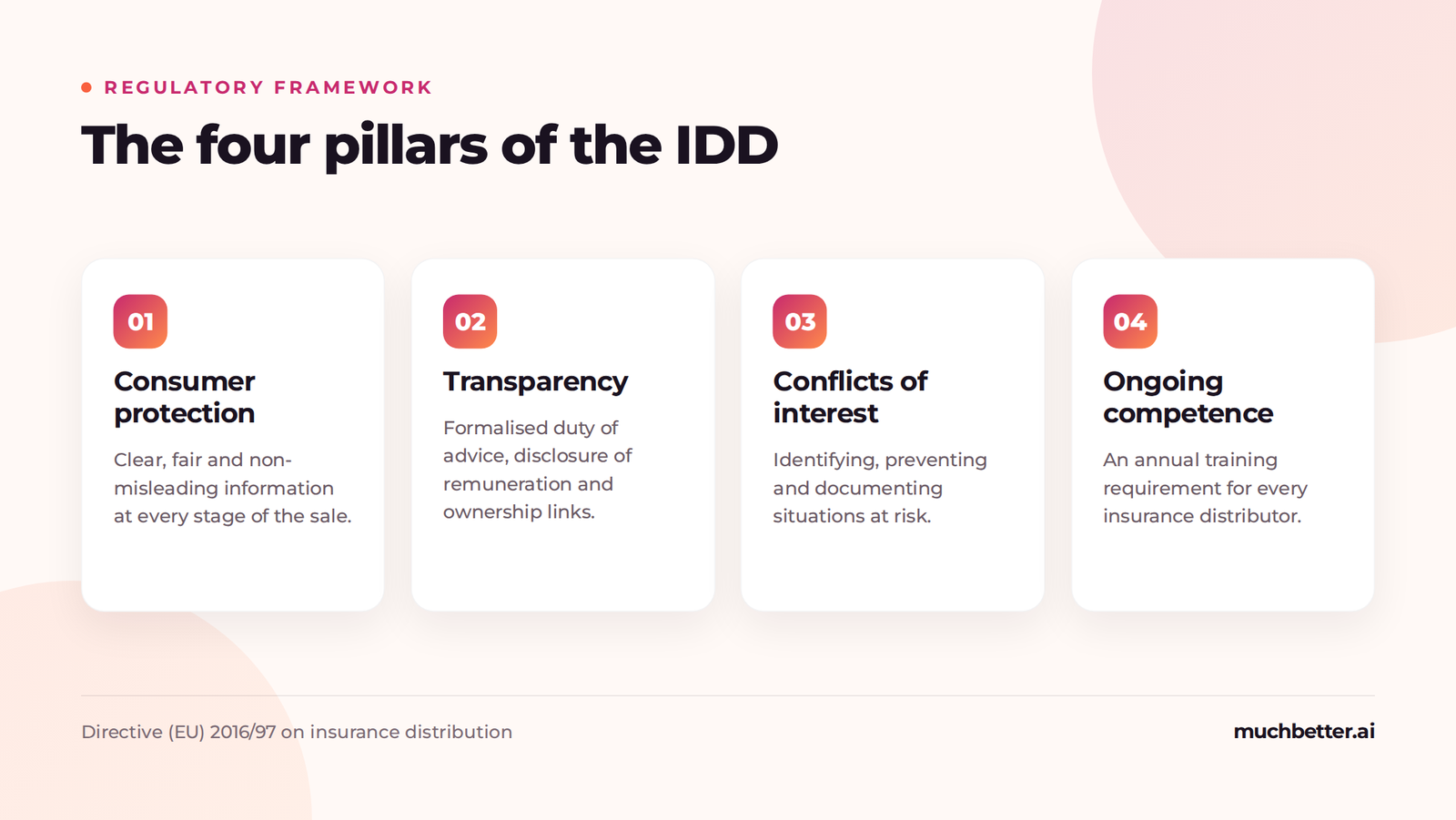
Continuing training under the IDD is a binding legal requirement. It ensures insurance professionals remain competent and up to date, and it raises the quality of the service clients receive.
The stakes are significant: maintaining high professional standards, but also reducing the risk of errors and misunderstandings during the sales process.
The IDD sets a minimum number of training hours each year. The exact volume varies between member states, but the principle applies to everyone: professionals must keep pace with market and regulatory developments.
Continuing training is also a personal and professional development tool. It helps individuals shape their career path and stay competitive, and it gives organisations better-qualified, more effective teams.
The 15-hour IDD training pack sits at the centre of most compliance programmes. It provides a complete refresh on the essentials of the sector and meets the requirements set out by the directive.
Its modules cover a broad range of topics: legislative developments, best practice and concrete cases. That breadth is what makes the programme both comprehensive and practical.
Among the key themes are beneficiary clauses and remote selling. Both are frequent sources of confusion, which is precisely why dedicated modules matter.
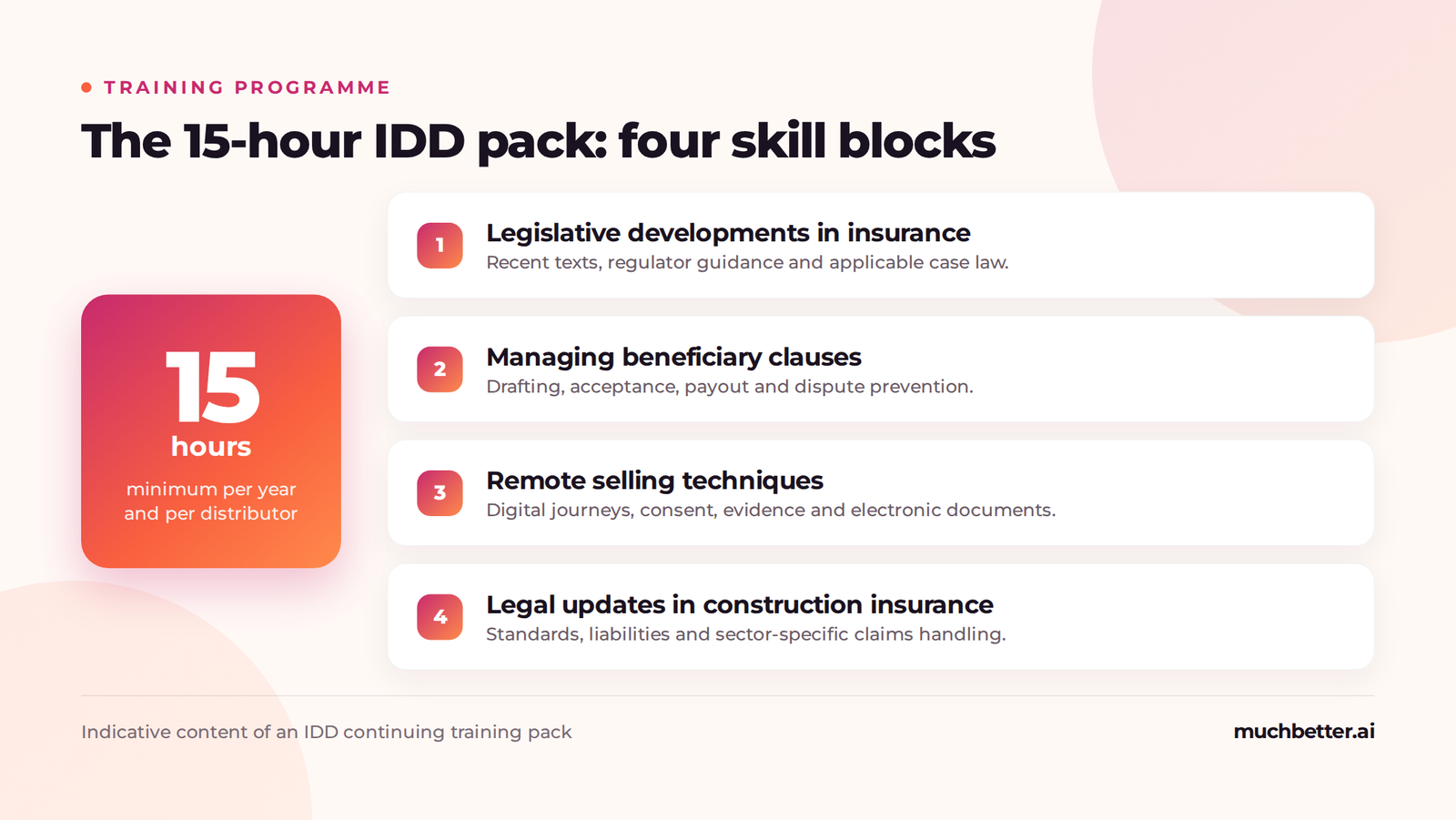
The pack is also an opportunity to engage with experts. Those exchanges help professionals grasp emerging trends and improve day-to-day effectiveness while meeting their legal obligations.
The beneficiary clause is a decisive element of an insurance contract. Understanding its subtleties is essential to avoid disputes, and IDD training covers the topic in detail.
Training teaches professionals how to draft clear, precise clauses. It also stresses the importance of transparent communication with clients, which reduces potential ambiguity.
Modules on beneficiary clauses typically include:
With this grounding, agents manage beneficiary clauses more confidently and minimise the risk of conflict, which strengthens client satisfaction and retention.
Construction insurance is subject to frequent regulatory change. Professionals need to keep track of legal developments, and IDD training integrates these updates into its programme.
It provides detailed briefings on current and upcoming regulations, covering legal compliance and best practice. Themes usually include:
Insurance specialists are then better equipped to anticipate changes in the legal framework and to give their clients stronger protection.
Digitalisation has transformed how insurance products are sold. IDD training gives professionals the skills to adapt to these new methods, with compliance at the heart of the transition.
It emphasises ethics and transparency, the two pillars of remote selling, and the importance of clear communication. Professionals learn how to build trust online.
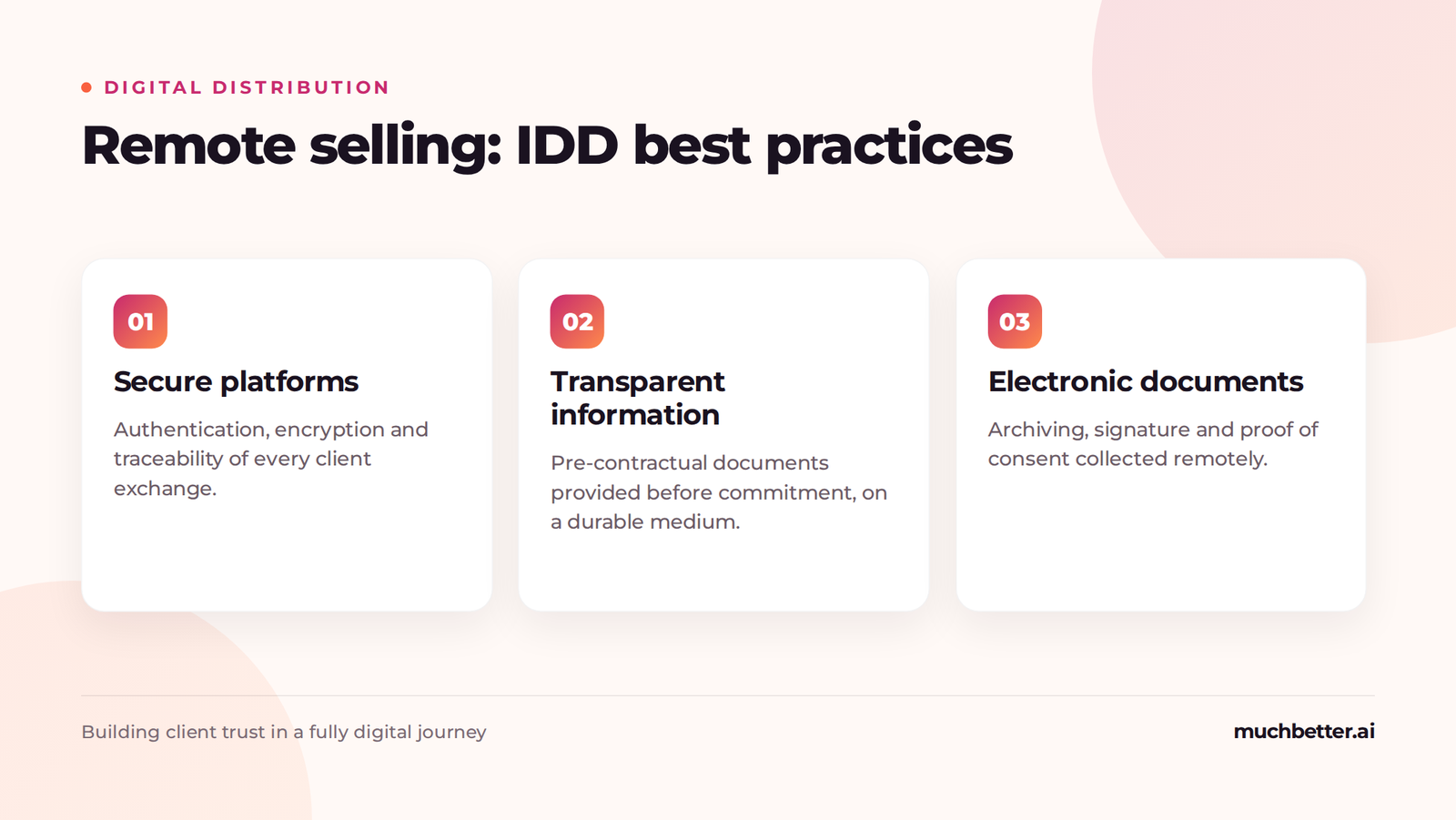
Best practices include:
Applied online, these practices deliver a better client experience. IDD training ensures agents are properly prepared to deliver quality service at a distance, strengthening their organisation's position in an increasingly digital market.
IDD training concerns a wide range of roles. It applies above all to brokers, insurance agents and compliance officers, who must master the regulatory and ethical requirements.
The obligation exists to ensure that everyone involved stays informed of the standards in force, whether they sell products or manage client relationships.
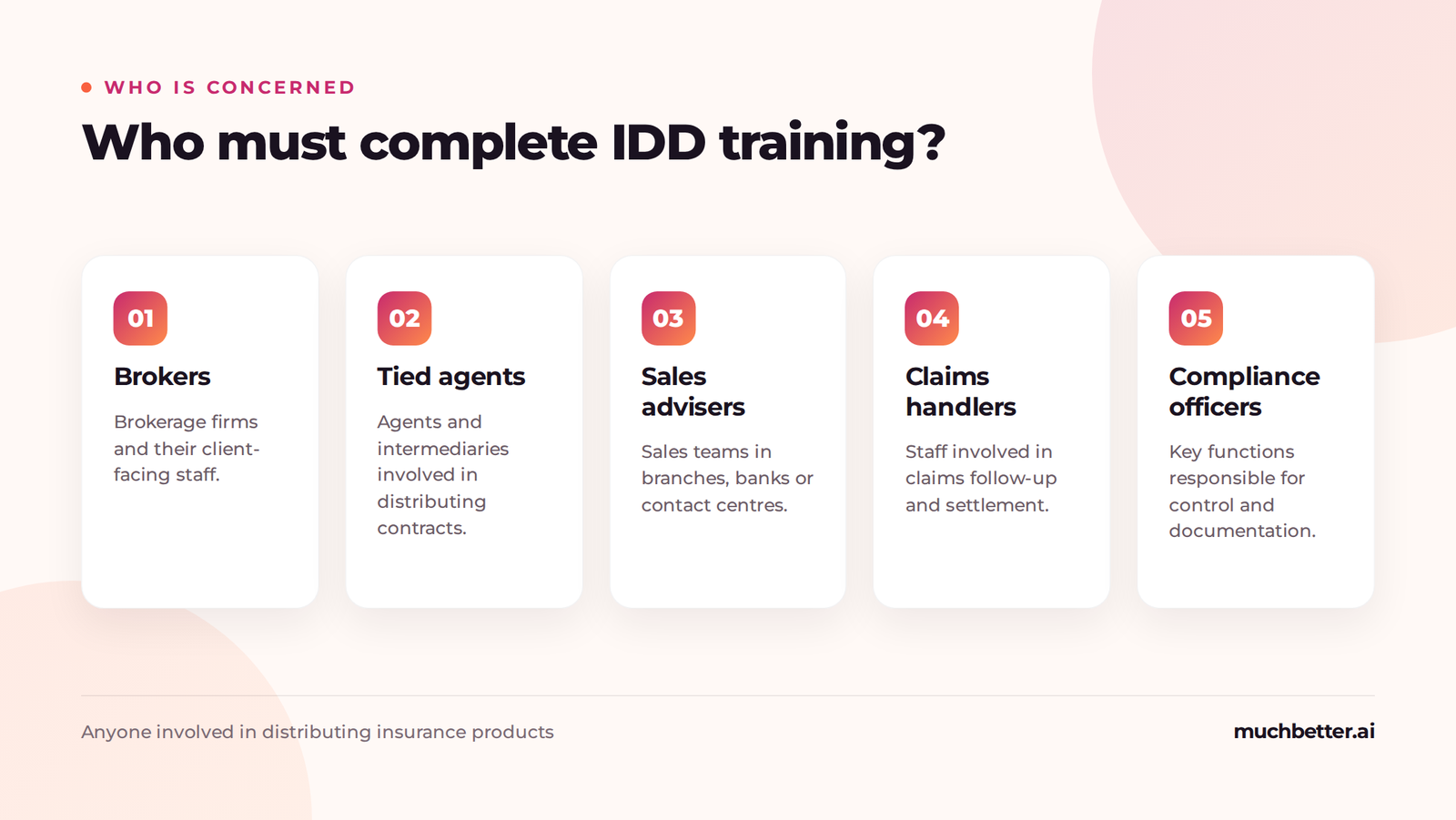
The roles concerned typically include:
Making sure these professionals receive the training they need is a guarantee of trust and quality for consumers.
Choosing the right IDD programme matters for both compliance and performance. Content quality and provider reputation come first.
Professionals should also weigh the formats on offer. Online, in-person or hybrid: each has its advantages, and adaptability to personal and professional constraints is decisive.
Criteria worth considering:
Finally, read reviews and feedback from other professionals. They offer valuable perspective when making a choice.
Building IDD training into your development plan is a strategic move. It supports continuous growth and deeper expertise, and it helps you anticipate change in the sector.
IDD training is not only about compliance: it broadens your skill set and strengthens your competitiveness. To integrate it effectively:
Continuous learning also fuels innovation, making it easier to respond to emerging challenges — with clear benefits for both professional and personal growth.
Professionals who complete IDD training consistently report sharper expertise and a better understanding of client needs. Three points come up most often:
This feedback underlines the value of continuing training: it energises careers and improves professional performance.
IDD training keeps evolving to meet new sector requirements. The digitalisation of modules is a defining trend, giving professionals flexible, personalised access.
Technology is also reshaping the content itself. Trends to watch include:
These developments keep training relevant and support the continuous improvement of skills across the insurance sector.
The directive sets a minimum annual volume of continuing training for every insurance distributor. In France that volume is 15 hours per year, which is why "15-hour IDD" packs are so widespread.
Yes. It is an annual, ongoing obligation that must be documented and evidenced in the event of an inspection.
Yes. E-learning, virtual classrooms and hybrid formats are accepted, provided the training is traceable and its content matches the required themes.
The employer or intermediary must retain the certificates and the register of hours completed by each member of staff concerned.
IDD training is essential for everyone active in insurance distribution. It delivers regulatory compliance and the continuous improvement of professional skills, making it a strategic tool for anticipating market trends.
By focusing on quality and up-to-date content, IDD training helps organisations stay competitive. It also improves client relationships through a sharper understanding of needs and products.
Investing in IDD training strengthens organisational performance and fosters a culture built on compliance and excellence. It is an indispensable lever for navigating a sector in constant evolution.

An AI sales training platform helps sales teams improve skills through guided practice, feedback, and repeatable training workflows. Instead of relying only on theory, reps can train with realistic scenarios, get coaching recommendations, and track progress over time. The goal is faster onboarding, stronger messaging, and better performance in real customer conversations.
Most AI sales training platforms combine structured learning paths with interactive practice. Reps train with scenarios (discovery, objections, demos), receive feedback on what to improve, and managers can monitor readiness with scorecards. The platform typically supports onboarding, continuous coaching, and certification gates to validate skills before reps go live.
It’s designed for sales leaders, enablement, and L&D teams who want consistent training at scale. It’s also useful for SDRs, AEs, and customer-facing teams that need to ramp quickly, practice messaging, and improve performance without depending solely on ad-hoc manager time.
AI sales training isn’t a replacement for managers, it’s a way to standardize and scale practice. Traditional training often focuses on content (slides, playbooks). An AI sales training platform adds structured repetition, feedback loops, and measurable progress, helping teams move from knowledge to real execution faster.
Common use cases include discovery calls, objection handling, qualification, negotiation, demo delivery, and follow-up messaging. Many teams also use AI training for onboarding, product updates, new pitch rollouts, and role-specific readiness (SDR vs AE). The best platforms support continuous improvement, not one-off workshops.
Yes. A strong AI sales training platform accelerates onboarding by giving reps clear weekly milestones, guided practice, and certification gates. This helps reduce time-to-first-meeting and time-to-first-opportunity, while giving managers visibility into readiness, so coaching is targeted instead of generic.
ROI is typically measured through ramp time reduction, improved conversion rates, higher win rates, shorter sales cycles, and better call quality. Many teams also track training completion, certification scores, and manager coaching hours saved. The most important metric is consistent performance improvement across the team, not just top reps.
No. It supports managers by automating practice routines and surfacing clear coaching signals. Managers stay focused on strategy, deal coaching, and real performance conversations, while the platform helps reps build skills through repeatable training and feedback between 1:1 sessions.
Look for realistic practice scenarios, clear feedback that reps can act on, manager dashboards, onboarding workflows, and easy content updates for messaging changes. Also check how the platform supports certification and continuous training, not just one-time sessions. Adoption is usually driven by simplicity and time-to-value.