Turn Sales Skills into Measurable Revenue Performance
April 2, 2026



Publié
8/6/26
Sales training and sales coaching are often used interchangeably. However, they serve distinct purposes in sales development. Understanding their differences is crucial for maximizing sales team performance.
Sales training focuses on imparting specific skills and knowledge. It is structured and often delivered in a classroom setting. This approach is ideal for onboarding new sales reps or introducing new products.
On the other hand, sales coaching is more personalized. It involves ongoing, one-on-one sessions that focus on individual growth. Coaching helps sales professionals apply their knowledge effectively.
Both methods are essential for a well-rounded sales strategy. Knowing when to use each can significantly enhance your team's success.
Sales training is designed to provide sales teams with the essential skills they need. It focuses on developing specific competencies through structured programs.
Typically, sales training sessions are held in classrooms or workshops. These settings allow for interactive learning. Participants engage with various materials to enhance their understanding.
Training often includes role-playing, seminars, and e-learning modules. These activities help sales reps practice and refine their skills.
Here are some key aspects of sales training:
Sales training aims to establish a common baseline among team members. It ensures everyone understands core sales techniques and concepts. This approach is particularly beneficial during the onboarding process for new hires or when introducing new products to existing teams.
In essence, sales training establishes a foundation. It prepares sales professionals for the challenges they may face in the field. This foundational knowledge is crucial for achieving consistent sales performance.
Sales coaching is a tailored approach focusing on individual growth. Unlike training, it is an ongoing process aimed at personal development. The coaching process addresses each team member’s unique strengths and areas for improvement.
Coaching typically involves one-on-one sessions between the coach and the sales professional. These sessions provide real-time feedback and support. The personalized nature of coaching makes it effective for long-term growth.
A crucial part of sales coaching is goal setting. Coaches work with sales reps to create personalized action plans. These plans help salespeople tackle specific challenges and reach their full potential.
Key elements of sales coaching include:
Sales coaching encourages self-reflection and accountability. Sales professionals learn to evaluate their performance and identify areas for improvement. This process helps foster a mindset of continuous learning and improvement.
Ultimately, sales coaching aims to elevate individual performance. By addressing personal barriers and enhancing unique strengths, coaching helps salespeople achieve success and satisfaction in their roles.
Sales training and coaching serve different purposes in sales development. Understanding these differences helps in applying them effectively. Let’s explore how they differ in approach and outcomes.
Sales training focuses on imparting specific skills and knowledge. It's often delivered in structured environments, like workshops or seminars. This method is ideal for teaching product details and sales techniques.
In contrast, sales coaching is personalized and ongoing. It involves tailored feedback and real-time support. Coaching is less about formal teaching and more about personal growth and development.
Training is typically a short-term engagement. It provides foundational knowledge quickly. This makes it suitable for onboarding or team-wide updates.
Coaching, however, is a long-term commitment. It evolves with the individual’s career progression. Coaching targets specific barriers to improve performance over time.
Here are some key distinctions:
Coaching requires active listening and empathy. It helps identify personal goals and areas for improvement. These aspects foster accountability and self-reflection.
Choosing between training and coaching involves assessing your team's needs. A balanced approach can yield the best results. Integrating both ensures a well-rounded sales development strategy.

Knowing when to choose sales training over coaching is crucial for optimizing sales performance. Different scenarios call for different approaches.
Sales training is excellent for onboarding new team members. It ensures they understand your products and processes. Training is also beneficial when introducing new tools or updating product lines.
Conversely, sales coaching is perfect for addressing individual performance issues. It provides support for overcoming personal challenges. Coaching helps sales reps refine their skills continuously.
Consider using training for team-wide skill building. It fosters a common understanding across the group. Training sessions can efficiently convey necessary information to large audiences.
On the other hand, coaching is best when focusing on personal development. It allows customization to fit each person's needs. This method creates opportunities for personalized growth.
Here's a quick guide on when to use each method:
Ultimately, the choice between sales training and coaching depends on specific goals. Assessing team needs carefully will guide your decision. Both methods play a vital role in building a strong sales force.
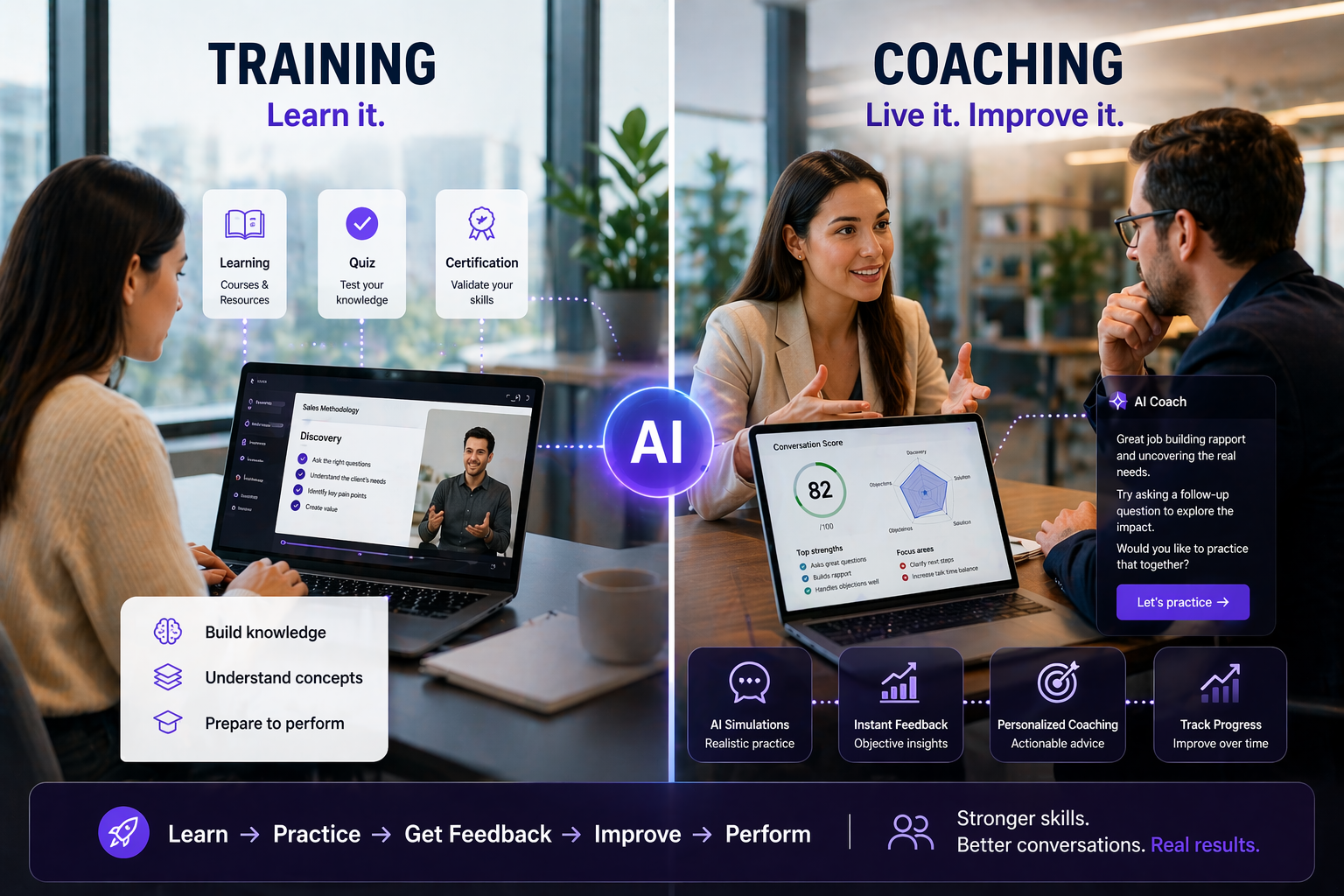
Combining sales training with coaching creates a comprehensive development strategy. Each approach contributes uniquely to building a high-performing sales team.
Start by providing foundational knowledge through structured training programs. Use workshops, seminars, and e-learning modules to introduce essential sales concepts and techniques.
Once the basics are established, integrate coaching for personalized guidance. Coaches can work with individuals to apply their training in real-world scenarios, offering feedback and motivation.
Create a continuous learning cycle by scheduling regular follow-ups between training sessions and coaching meetings. This helps reinforce skills and address emerging challenges promptly.
To maximize effectiveness, align both training and coaching with overall company goals. Ensure they target specific performance metrics, boosting both individual and team success.
Key strategies for combining training and coaching:
By leveraging both approaches, sales professionals can gain comprehensive support. This integrated method enhances skills, performance, and career growth over time.
Let's explore how companies implement sales training and coaching effectively. Each example showcases unique ways these approaches drive success.
A tech company used sales training to onboard new hires rapidly. They employed interactive role-playing sessions and e-learning modules. This method helped new sales reps quickly understand product nuances and sales processes.
In contrast, a multinational firm embraced sales coaching for ongoing development. Managers held weekly one-on-one sessions, offering tailored guidance and feedback. This personal touch improved individual performance and boosted team morale.
Another example is a retail giant combining both methods. They started with comprehensive training to establish foundational skills across teams. This was followed by continuous coaching to personalize the learning journey.
These real-world applications illustrate the versatility and impact of training and coaching. They prove the importance of applying each approach strategically to address specific needs.
Key real-world strategies:
Through these strategies, businesses enhance sales performance and achieve remarkable results.
Selecting between sales training and sales coaching depends on your team's needs. Analyze your team's current skill level and identify specific gaps or challenges.
Consider the goals you want to achieve. Training is useful for imparting knowledge and skills quickly, while coaching is better for personalized growth and behavioral change.
A balanced approach may yield the best results. Use training to lay the groundwork and coaching to fine-tune individual performance. This combination can drive continuous improvement.
Creating a top-notch sales team requires more than just basic skills. Blend the strengths of both sales training and sales coaching.
Sales training equips your team with crucial knowledge and techniques. Sales coaching enhances individual growth, fostering stronger communication and problem-solving skills.
Together, they create a comprehensive development strategy. This leads to continuous progress and success. By investing in both approaches, you build a resilient, high-performing sales team ready to meet new challenges head-on.
Because knowledge does not translate into behavior automatically.
Without repetition and feedback, sales reps revert to their default habits in real conversations.
This creates a persistent gap between what teams know and what they actually do in the field.
Sales coaching solves the execution problem.
It focuses on:
It turns theory into repeatable, on-the-job performance.
Because complexity increases the gap between knowledge and execution.
In high-stakes sales (B2B, financial services, pharma), success depends on:
These are behavioral skills, not theoretical ones—therefore they require coaching, not just training.
Not as alternatives, but as two layers of the same system:
Without training, teams lack structure.
Without coaching, structure is never applied.
High-performing organizations operate a continuous loop:
Define → Train → Practice → Coach → Measure → Repeat
This shifts the model from “learning events” to a performance system where skills are continuously developed and linked to business outcomes.
Your reps end up practicing on real customers.
Without a safe environment to train and receive feedback:
This is one of the largest invisible costs in sales organizations.
AI collapses the gap between the two.
It enables:
This transforms training from a one-time event into a continuous execution system.

An AI sales training platform helps sales teams improve skills through guided practice, feedback, and repeatable training workflows. Instead of relying only on theory, reps can train with realistic scenarios, get coaching recommendations, and track progress over time. The goal is faster onboarding, stronger messaging, and better performance in real customer conversations.
Most AI sales training platforms combine structured learning paths with interactive practice. Reps train with scenarios (discovery, objections, demos), receive feedback on what to improve, and managers can monitor readiness with scorecards. The platform typically supports onboarding, continuous coaching, and certification gates to validate skills before reps go live.
It’s designed for sales leaders, enablement, and L&D teams who want consistent training at scale. It’s also useful for SDRs, AEs, and customer-facing teams that need to ramp quickly, practice messaging, and improve performance without depending solely on ad-hoc manager time.
AI sales training isn’t a replacement for managers, it’s a way to standardize and scale practice. Traditional training often focuses on content (slides, playbooks). An AI sales training platform adds structured repetition, feedback loops, and measurable progress, helping teams move from knowledge to real execution faster.
Common use cases include discovery calls, objection handling, qualification, negotiation, demo delivery, and follow-up messaging. Many teams also use AI training for onboarding, product updates, new pitch rollouts, and role-specific readiness (SDR vs AE). The best platforms support continuous improvement, not one-off workshops.
Yes. A strong AI sales training platform accelerates onboarding by giving reps clear weekly milestones, guided practice, and certification gates. This helps reduce time-to-first-meeting and time-to-first-opportunity, while giving managers visibility into readiness, so coaching is targeted instead of generic.
ROI is typically measured through ramp time reduction, improved conversion rates, higher win rates, shorter sales cycles, and better call quality. Many teams also track training completion, certification scores, and manager coaching hours saved. The most important metric is consistent performance improvement across the team, not just top reps.
No. It supports managers by automating practice routines and surfacing clear coaching signals. Managers stay focused on strategy, deal coaching, and real performance conversations, while the platform helps reps build skills through repeatable training and feedback between 1:1 sessions.
Look for realistic practice scenarios, clear feedback that reps can act on, manager dashboards, onboarding workflows, and easy content updates for messaging changes. Also check how the platform supports certification and continuous training, not just one-time sessions. Adoption is usually driven by simplicity and time-to-value.