Turn Sales Skills into Measurable Revenue Performance
April 2, 2026



Publié
16/3/26
Cold calling is the practice of reaching out to prospects by phone without any prior interaction with your company. Despite its sometimes negative reputation, it remains one of the most effective outbound levers in B2B to start conversations, qualify quickly, and book meetings.
But in 2026, cold calling is no longer won by “talent” or improvisation. High-performing teams win with a simple method, solid call frameworks, and most importantly : consistent training.
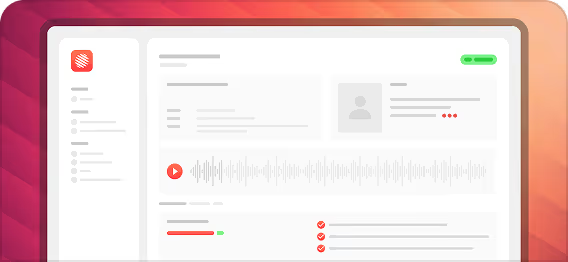
That’s where platforms like muchbetter.ai change the game: they enable sales teams to train with realistic AI call simulations, receive structured feedback, and track skill progress over time without relying on sporadic roleplays or busy managers.
In this guide, you’ll learn:
Cold calling is a B2B prospecting technique where a salesperson calls a prospect “cold” meaning:
In B2B, the goal is rarely to close the deal during the call. The real goal is to:

Phone calls generate immediate signal: interest, rejection, redirection, timing. Unlike email, you don’t wait days for silence you learn something in minutes.
Tone, listening, and smart follow-ups matter. A good cold call feels more like a micro discovery than a pitch.
In a few minutes, you can validate:
The classic mistake is thinking: “We just need more volume.”
In reality, teams that win have:
The problem? Training is hard to scale:
This is exactly what AI simulations solve: reps can run cold call scenarios, test openings, face objections, and receive structured feedback without burning real leads.
Cold calling performance is often decided before you dial. The fastest way to improve outcomes is to standardize a short pre-call routine. Before each call, confirm three things: (1) who you’re calling, (2) why now, and (3) what you want as a next step. Even two minutes of preparation can dramatically increase relevance and confidence on the call.
A simple checklist:
Industry, company size, growth signals, tech stack, org structure, sales cycle… The clearer your ICP, the more credible your opening.
A trigger makes the call feel less “cold”: hiring, expansion, fundraising, tool change, new market entry, website redesign, leadership change, etc.
Your goal is not to pitch. It’s to earn the right to ask 1–2 questions.
Your job is to get the prospect talking.
Show you understood their situation (and that you’re not reading a robotic script).
“15–20 minutes. One objective. We’ll see if it’s worth going further.”
Cold calls work best inside a sequence: call → email → LinkedIn → follow-up call.
“Hi [Name], this is [First name].
You don’t know me, so I’ll keep it short: we help [company type] achieve [result] without [friction].
Can I take 20 seconds to see if this is relevant—otherwise we can hang up?”
“Hi [Name], I’m calling because I noticed [trigger].
Often when that happens, teams run into [common issue].
Quick question: how are you handling [topic] today?”
“To understand your context: how do you currently handle [problem]?
And what’s the biggest frustration—more [A], [B], or [C]?”
“Based on what you said, it’s worth a quick 15-minute chat to see if we can help in a practical way.
Would you prefer [slot 1] or [slot 2]?”
“Totally fair. One quick question: is [topic] already fully handled, or is there room to improve?”
“Of course. So it’s not just another email—should I frame it around [A] or [B]?”
“Got it. What’s working well today—and what still frustrates you?”
Cold calling is a skill set: opening, questioning, listening, handling objections, and securing a next step. Skills improve with frequent, structured practice and measurable feedback.
With muchbetter.ai, your teams can:
Result: a training system that’s clear, scalable, and actionable for SDRs, AEs, and managers—without waiting for “when we have time” roleplays.
Track a small set of KPIs consistently:
If you’re getting conversations but not meetings, the issue is usually:
opening + questions + next step exactly the skills AI simulations help train and measure.
Most cold calling teams focus on scripts, but the biggest lever is often reachability. If your connection rate is low, your pipeline will always suffer no matter how good your pitch is. To improve it, test these levers systematically:
Treat connection rate like a growth metric: measure, experiment, and iterate.
Most cold calls fail for predictable reasons:
Fixing these doesn’t require a new script—it requires a tighter structure and consistent training.
Cold outreach is increasingly regulated (especially for consumers), and rules evolve by country. From a privacy standpoint, regulators generally expect:
For a complete legal framework adapted to your situation and geography, get your process validated by counsel.
Cold calling remains powerful in B2B—if it’s structured and trained. The best outcomes don’t come from a “magic script,” but from a simple loop:
targeting → calling → feedback → training → improvement
That’s exactly what muchbetter.ai enables: realistic AI simulations, actionable feedback, and measurable progression via a competency map.
Cold calling is calling a prospect without prior interaction (no inbound request, no form, no meeting). In B2B, the goal is usually qualification and booking a short next step.
Warm calls are easier—but cold calls still work well with the right method.
To create a useful conversation that verifies ICP fit, identifies priority/timing, uncovers pain, and secures a clear next step (meeting, intro, follow-up).
Yes especially in B2B. But performance depends less on volume and more on targeting, permission-based opening, 2–3 questions, a clear next step, and a training loop.
Call decision-makers or key influencers (CEO, Head of Sales, CMO, CIO, Ops leaders). Avoid calling randomly without ICP, role clarity, or a hypothesis.
It depends, but common high-performing windows are:
Test 2–3 time windows and measure connection and meeting rates.
Depends on personalization:
The best KPI isn’t volume it’s qualified conversations → meetings → opportunities.
Yes but not a text to recite. A good script is a framework: opening, 2–3 questions, reflection, next step, and short objection responses.
“Hi [Name], this is [First name]. You don’t know me, so I’ll keep it short… Can I take 20 seconds to see if this is relevant otherwise we can hang up?”
Keep it to 2–3:
A short, non-pushy response:
“Totally fair. Quick question: is [topic] already handled, or is it still a bit imperfect?”
Turn it into micro qualification:
“Of course—should I orient it around [A] or [B] so it’s actually useful?”
Sometimes, yes—keep it short (10–15 seconds) and use it inside a sequence (call + email + LinkedIn + follow-up). Avoid long voicemails.
Yes. Cold calling complements inbound by accelerating qualification, reactivating warm signals, and collecting field feedback (objections, messaging, offer insights).
An AI sales training platform helps sales teams improve skills through guided practice, feedback, and repeatable training workflows. Instead of relying only on theory, reps can train with realistic scenarios, get coaching recommendations, and track progress over time. The goal is faster onboarding, stronger messaging, and better performance in real customer conversations.
Most AI sales training platforms combine structured learning paths with interactive practice. Reps train with scenarios (discovery, objections, demos), receive feedback on what to improve, and managers can monitor readiness with scorecards. The platform typically supports onboarding, continuous coaching, and certification gates to validate skills before reps go live.
It’s designed for sales leaders, enablement, and L&D teams who want consistent training at scale. It’s also useful for SDRs, AEs, and customer-facing teams that need to ramp quickly, practice messaging, and improve performance without depending solely on ad-hoc manager time.
AI sales training isn’t a replacement for managers, it’s a way to standardize and scale practice. Traditional training often focuses on content (slides, playbooks). An AI sales training platform adds structured repetition, feedback loops, and measurable progress, helping teams move from knowledge to real execution faster.
Common use cases include discovery calls, objection handling, qualification, negotiation, demo delivery, and follow-up messaging. Many teams also use AI training for onboarding, product updates, new pitch rollouts, and role-specific readiness (SDR vs AE). The best platforms support continuous improvement, not one-off workshops.
Yes. A strong AI sales training platform accelerates onboarding by giving reps clear weekly milestones, guided practice, and certification gates. This helps reduce time-to-first-meeting and time-to-first-opportunity, while giving managers visibility into readiness, so coaching is targeted instead of generic.
ROI is typically measured through ramp time reduction, improved conversion rates, higher win rates, shorter sales cycles, and better call quality. Many teams also track training completion, certification scores, and manager coaching hours saved. The most important metric is consistent performance improvement across the team, not just top reps.
No. It supports managers by automating practice routines and surfacing clear coaching signals. Managers stay focused on strategy, deal coaching, and real performance conversations, while the platform helps reps build skills through repeatable training and feedback between 1:1 sessions.
Look for realistic practice scenarios, clear feedback that reps can act on, manager dashboards, onboarding workflows, and easy content updates for messaging changes. Also check how the platform supports certification and continuous training, not just one-time sessions. Adoption is usually driven by simplicity and time-to-value.