PLAYBOOK – How to Ramp Up Your Sales Team with AI


Ressource téléchargeable
.png)
Download your resource now
Below is a word-for-word English translation as close as possible to the French structure and wording (not stylistically optimized), keeping references like [1], [2], etc. exactly as in the original.
How to transform theoretical knowledge into measurable sales performance.
Every year, companies invest massively in the training of their sales forces. Yet, the reality in the field is often disappointing: a large part of what is taught in the training room is forgotten or is never really applied in customer meetings.
This guide shows you how AI training transforms this paradigm.
It is aimed at sales directors, training and sales enablement managers, learning and development leaders, and anyone responsible for sales performance.
We built this guide after analyzing more than 200,000 anonymized AI simulations, in sectors such as banking, insurance, industry, and healthcare.
You will find methods, use cases, and concrete examples to launch an effective continuous sales training program, at scale.
In many organizations, there is a lack of real follow-up after training sessions.
Without exercises or post-training reminders, “training loses its role as a transformation lever. It becomes a cost center… the ‘training’ box is checked but nothing changes in the field” [1].
As a consequence, salespeople return to the field without having developed new reflexes, and managers do not observe any tangible improvement in sales.
“Classic” sales training (in-person workshops, e-learning modules, occasional coaching) now show their limits:
Ephemeral memorization without regular practice – Without reinforcement, most acquired knowledge disappears within a few days or weeks. A salesperson can leave a product training smiling in the morning, and have forgotten most of the content the following month.
No change in the field without follow-up – Once the session ends, everyone goes back to their business and “we move on.” Without a post-training action plan, without practical exercises or later feedback, the new techniques taught remain theoretical.
Almost nonexistent personalization and measurement – In traditional training, all salespeople receive the same content, regardless of their level. Managers have little visibility on what has actually been retained or improved. Leadership has no detailed visibility on the real competencies of their salespeople, beyond the sales numbers alone.
High cost for limited effectiveness – Organizing in-person seminars, mobilizing trainers, making entire teams travel—all of this is heavy. Budgets are shifting away from expensive in-person formats toward digital solutions that are scalable and with measurable ROI.
The problem is not resistance from teams – 44% of salespeople even consider training as the number one lever of motivation in sales [2].
The problem is the effectiveness of the existing training methods that fail to personalize, repeat, and measure each person’s progress.
💡 Key takeaway: training ≠ practice.
The real impact comes from the combination of
Sports, music, medicine… all complex professions rely on practice.
Why not sales?
Hence the emergence of a new and more dynamic model: continuous AI-driven sales training.
A system where salespeople practice regularly through AI-assisted sales simulations, capable of playing the role of a customer or prospect.
In practice, it looks like a role-play, but with an intelligent conversational agent that embodies the client and adapts in real time to the salesperson’s responses [3][4].
Studies on the forgetting curve show that without reinforcement, we lose up to 50% of the information learned within an hour, and 90% in only a few weeks [5].
In other words, a one-time training session—even a high-quality one—can see 90% of its content evaporate if it is not followed by practice and revision.
The key lies in spaced repetition and regular practice.
By replaying key situations periodically, good techniques gradually become reflexes.
The analysis of more than 30,000 simulations allowed us to identify repetition thresholds to anchor skills sustainably:
• 6 to 8 repetitions to validate technical knowledge
(example: new offer, product characteristic, key message)
• 10 to 12 repetitions to anchor a behavioral reflex or a sales method
(example: objection handling, closing, discovery conversation)
This approach fully aligns with the principle of deliberate practice, meaning targeted training, repeated and accompanied by feedback, leading to continuous improvement in performance [6].
Learning is no longer an event.
It is a permanent process integrated into the daily routine of your salespeople.
Knowledge stays fresh and is regularly reactivated instead of being forgotten.
Why treat a senior and a junior differently? Because they do not have the same strengths or the same weaknesses.
AI training stands out through three key characteristics:
• frequent
• individualized
• measurable.
A few minutes of simulation are enough to replay a first meeting scenario, a price objection, or a closing conversation.
Once the exercise is finished, the platform generates a detailed score on predefined key competencies, for example:
• listening and rephrasing
• clarity of the pitch
• objection handling
• conversation structuring
• quality of the conclusion [4][7].
AI can identify specific weaknesses (tone, active listening, argumentation) to propose targeted corrective scenarios.
This score is accompanied by concrete advice to improve:
“think about asking more open questions”,
“rephrase the needs expressed by the client”,
“avoid interrupting” [8].
For the manager, these data make it possible to visualize the strengths and improvement areas of the team.
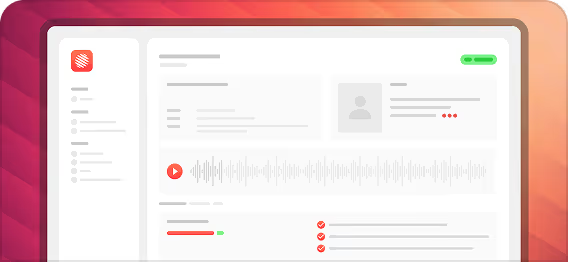
Everything is tracked in a dashboard, which allows the salesperson to follow their progress over time, and the manager to prioritize coaching actions [9].
A replacement for human management or a surveillance tool.
AI training does not replace traditional training entirely, but complements it effectively.
One can keep the following image in mind:
in-person training sets the framework, AI simulation installs winning habits.
A “coach assistant” that prepares the ground by managing the volume of practice.
A major advantage of AI sales simulations is providing clear, objective, and actionable feedback after each session.
Where a human trainer may lack time or perspective to finely evaluate each participant, AI can analyze each exchange according to predefined criteria [7][10].
Managers have dashboards to see who practices, at what rhythm, and where each person gets stuck.
For example, one can correlate that salespeople who practice a lot on price objections improve their real closing rate by X% in the field [11].
Weekly or bi-weekly check-ins are transformed:
Less time verifying knowledge (“Do you know your pitch?”)
More time on strategy and posture (“How do we win this deal?”)
This precise measurement of learning allows faster adjustments and above all demonstrates the ROI of training programs with facts.
Bouygues Telecom: training teams for excellence, at scale
With muchbetter.ai, Bouygues Telecom transformed its sales training. Targeted simulations enabled teams to adopt new offers faster and strengthen their selling posture both in-store and remotely.

+36%
Improvement in customer discovery skills
4.4/5
Average user satisfaction over 10.000+ feedbaks