Turn Sales Skills into Measurable Revenue Performance
April 2, 2026


Trusted by 100+ teams to level up their performance with muchbetter.ai
AI telecom sales training that turns your field teams into top performers fast.
Practice, improve, and perform.

4.8 / 5

Security &
compliance


Be ready for customer interactions
Methodology, product expertise, relational posture.
Practice in real-life situations with demanding virtual clients and receive instant feedback.
Manage your teams' skills and performance
Coach, guide, adjust.
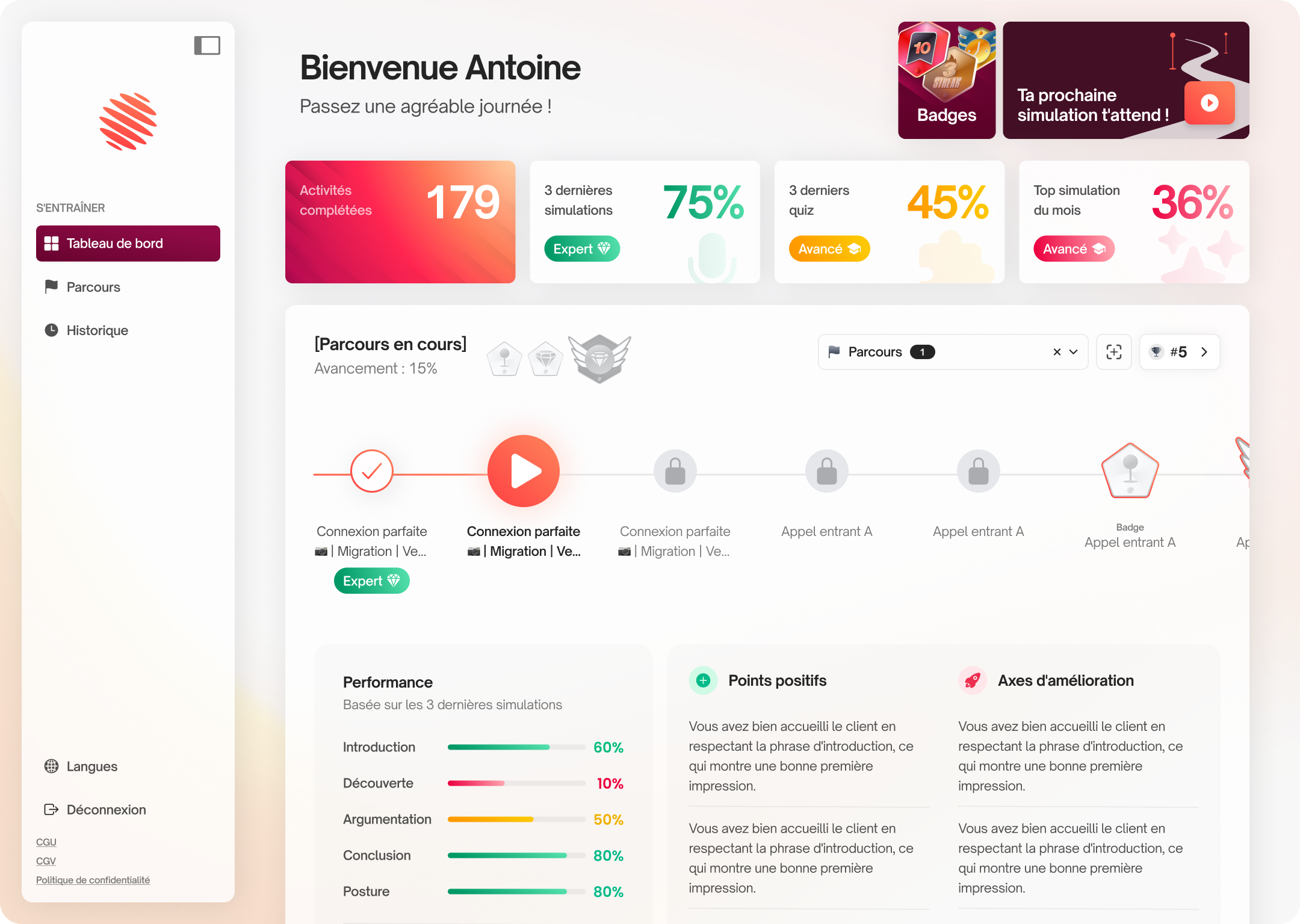
Access a clear dashboard showing your teams' scores and progress so you can better support them
Reduce performance gaps, align strategy and execution, accelerate new employee autonomy

Strategic transformations & product launches
New product? New strategy? New message? Your teams will quickly master them thanks to targeted training.


Accelerated onboarding
Your new employees become operational faster thanks to an immersive experience from day one.

Accurate performance diagnosis
Map strengths and areas for improvement to adapt your coaching to real field needs.

Continuous learning culture
Regular training loops to grow skills and raise the game for everyone

Reduce performance gaps, align strategy and execution, accelerate new employee autonomy

The gap between strategy and execution
Your strategic decisions struggle to reach the field? muchbetter.ai helps turn strategy into action and transform behaviors.
Dare to experiment with customers
Does testing your ideas with customers seem risky? muchbetter.ai gives you the freedom to experiment without fear.
Coaching without support
Hard to know where to focus coaching? muchbetter.ai gives you full visibility.

More demanding clients and markets
As expectations rise, muchbetter.ai helps your teams become sharper, more accurate, and impactful.
Telecom sales training is the process of developing the skills and product knowledge telecom sales teams need to sell connectivity and digital services effectively fiber, mobile plans, unified communications, SD-WAN, security add-ons, and managed services. In 2026, telecom sales training is critical because buyers expect consultative selling, pricing is complex, churn risk is high, and sales cycles often include multiple stakeholders (IT, procurement, finance, operations). Modern telecom sales training must help reps handle technical discovery, build a business case, and communicate value clearly. Muchbetter AI supports telecom sales training by enabling structured AI roleplays, standardized coaching, and skill tracking so teams can improve faster and stay consistent across regions.
Telecom is technical, contract-heavy, and full of trade-offs. Customers ask about SLAs, rollout timelines, coverage, hardware, integration, security, and support. On top of that, pricing can be messy (tiers, bundles, multi-sites, add-ons, promos, renewal clauses). Telecom sales training has to prepare reps to be credible in front of IT and procurement while still speaking business outcomes. It’s not just “sales skills.” It’s sales skills plus technical discovery plus value messaging.
At minimum: product positioning, discovery frameworks, objection handling, competitive messaging, and deal process discipline. But the best programs add practice in realistic situations: first-call discovery, “send me pricing,” competitor comparisons, procurement pressure, multi-site rollouts, migration risk, and renewal conversations. If reps only learn theory, they freeze when the prospect pushes back. Training works when practice is built into the weekly rhythm.
You teach them to quantify pain and link the offer to outcomes. In telecom that often means uptime, productivity, security risk reduction, call quality, support responsiveness, and total cost of ownership. The rep needs to ask better questions early, so later they can defend price with logic. It also helps to rehearse the difficult moments: “Your competitor is cheaper,” “We’ll only sign if you cut 20%,” “We need month-to-month,” “We don’t trust migrations.” With roleplay and coaching, reps stop reacting and start leading.
Start with what happens every week: inbound qualification, first-call discovery, setting next steps, pricing objections, competitor comparisons, and procurement negotiation. Then add segment-specific modules: SMB reps need speed and clarity; enterprise reps need stakeholder mapping, technical validation, and proposal discipline. Finally, include post-sale and renewal scenarios, because churn and expansion are often where telecom teams win or lose.
SMB training should focus on speed: quick discovery, packaging, common objections, clean close plans, and tight follow-up. Enterprise training needs deeper discovery, multi-stakeholder navigation, business case building, security and compliance conversations, and negotiation with procurement. It’s the same fundamentals, but the depth is different. The mistake is running one program for both and wondering why performance is uneven.
Managers should coach on behavior, not vibes. Was discovery structured? Did the rep ask questions that uncover business impact? Did they control the next step? Did they explain value in plain language? Did they handle objections without getting defensive? Telecom also needs coaching on credibility: when to go deep, when to simplify, and when to bring in a specialist. The goal is consistency. If every manager coaches differently, the team never converges on “what good looks like.”
Use a shared scorecard and a shared language. Define a small set of criteria that matter most for your motion (for example: discovery quality, value articulation, objection handling, next-step control). Then calibrate managers together so “a 4/5” means the same thing everywhere. Standardization doesn’t kill autonomy; it removes randomness. Once coaching is consistent, training becomes easier to scale, especially when you hire fast or expand into new markets.
AI roleplay helps reps practice more often, especially the tough scenarios that managers don’t have time to run every week. It’s useful for repetition and consistency: reps can rehearse discovery, objections, and negotiation until the basics become automatic. Managers still matter for judgment and nuance, but AI practice can reduce the time spent on fundamentals and free managers to coach the parts that truly move deals.