Transformez vos compétences commerciales en performances de revenus mesurables
April 2, 2026


Plus de 100 équipes font confiance à muchbetter.ai pour améliorer leurs performances
Simulations réalistes, feedback instantané et analyse des compétences pour faire progresser vos équipes plus vite.

4,8 sur 5

Sécurité et
conformité


Soyez prêt face aux clients
Méthodologie, expertise métier, posture relationnelle.
Entraînez-vous en conditions réelles avec des clients virtuels exigeants et bénéficiez d’un feedback instantané.
Pilotez les compétences et performances de vos équipes
Coachez, guidez, ajustez
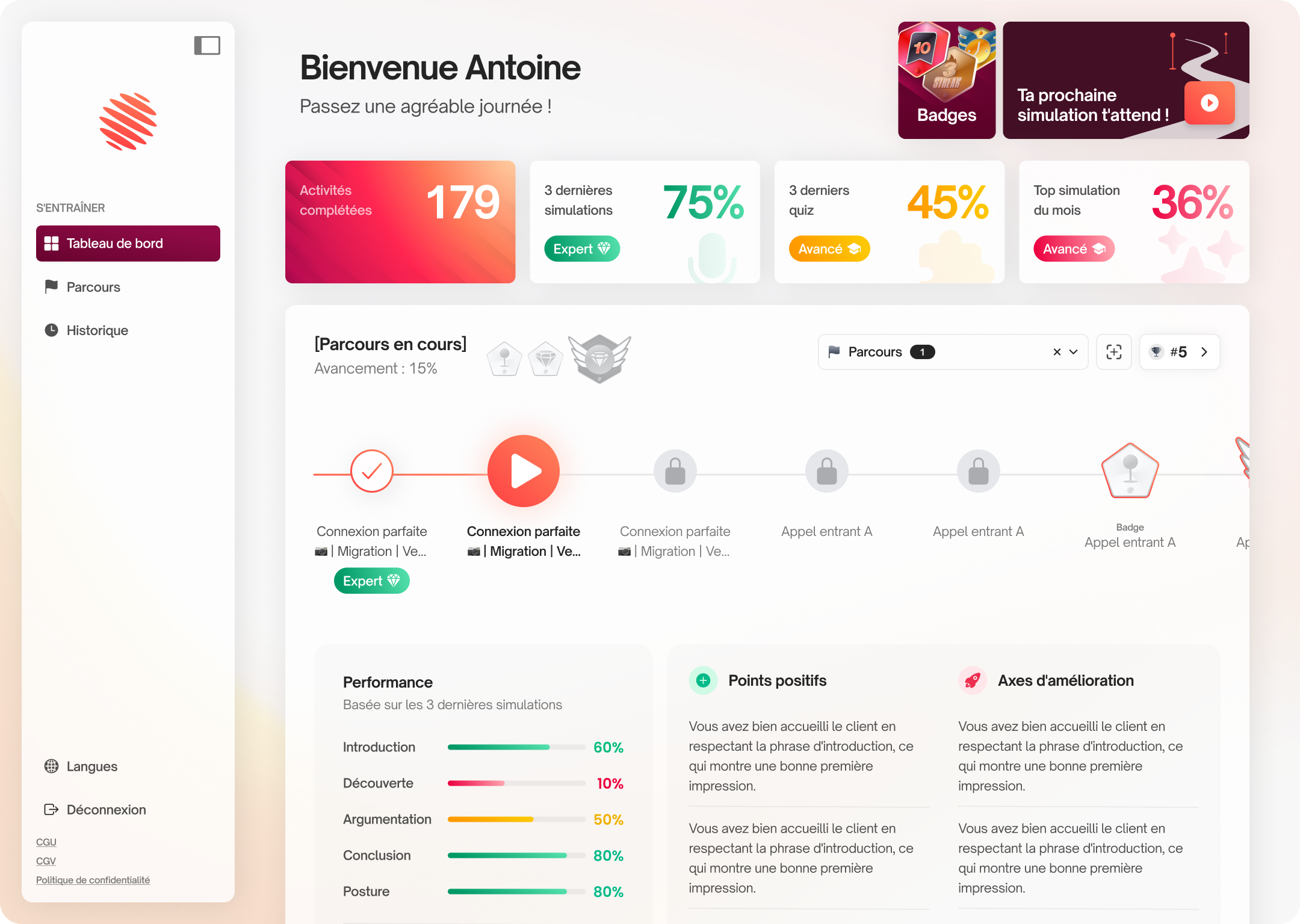
Accédez à un tableau de bord clair regroupant les scores et la progression de vos équipes pour mieux les accompagner.
Réduisez les écarts de performance, alignez stratégie et exécution, accélérez l’autonomie des nouveaux collaborateurs.

Transformations stratégiques et lancements de produits
Nouveau produit ? Nouvelle stratégie ? Nouveau message ? Vos équipes les maîtrisent rapidement grâce à un entrainement ciblé.


Onboarding accéléré
Vos nouvelles recrues deviennent opérationnelles plus vite grâce à un parcours immersif dès le premier jour.

Diagnostic précis des performances
Cartographiez les forces et les axes d'amélioration pour adapter votre coaching aux besoins réels du terrain.

Culture d'apprentissage continue
Des cycles d’apprentissage continus qui développent les compétences individuelles et montent le niveau de jeu général.

Réduisez les écarts de performance, alignez stratégie et exécution, accélérez l’autonomie des nouveaux collaborateurs.

L’écart entre stratégie et exécution
Vos décisions stratégiques peinent à se traduire sur le terrain ? muchbetter.ai vous accompagne dans la transformation des comportements et l'évolution de vos messages.
Risqué d’expérimenter face aux clients
Tester vos idées face au client semble risqué ? muchbetter.ai vous donne la liberté d’expérimenter sans crainte.
Coaching sans support
Comment savoir ou concentrer vos efforts de coaching ? muchbetter.ai vous donne la visibilité qu’il vous faut.

Clients et marché plus exigeants
Quand les attentes des clients et du marché augmentent, muchbetter.ai aide vos équipes à être plus expertes, justes et efficaces face aux clients.
Industrie, assurance, finance, pharmaceutique, télécom, retail
Chaque métier a ses spécificités, nous les intégrons toutes.
Formation à la vente en télécommunications est le processus qui consiste à développer les compétences et la connaissance des produits dont les équipes commerciales des télécommunications ont besoin pour vendre efficacement la connectivité et les services numériques, la fibre optique, les forfaits mobiles, les communications unifiées, le SD-WAN, les modules de sécurité et les services gérés. En 2026, formation à la vente de télécommunications est essentiel car les acheteurs s'attendent à des ventes consultatives, les prix sont complexes, le risque de désabonnement est élevé et les cycles de vente incluent souvent de multiples parties prenantes (informatique, achats, finances, opérations). Moderne formation à la vente de télécommunications doit aider les représentants à gérer les découvertes techniques, à élaborer une analyse de rentabilisation et à communiquer clairement la valeur. Supports d'IA Muchbetter formation à la vente de télécommunications en proposant des jeux de rôle structurés basés sur l'IA, un coaching standardisé et un suivi des compétences afin que les équipes puissent s'améliorer plus rapidement et rester cohérentes d'une région à l'autre.
Les télécommunications sont une activité technique, gourmande en contrats et pleine de compromis. Les clients posent des questions sur les SLA, les délais de déploiement, la couverture, le matériel, l'intégration, la sécurité et le support. En plus de cela, les prix peuvent être compliqués (niveaux, offres groupées, sites multiples, modules complémentaires, promotions, clauses de renouvellement). La formation à la vente dans le secteur des télécommunications doit préparer les représentants à être crédibles face à l'informatique et aux achats tout en parlant des résultats commerciaux. Il ne s'agit pas simplement de « compétences commerciales ». Il s'agit de compétences commerciales, de découvertes techniques et de messages de valeur.
Au minimum : positionnement des produits, cadres de découverte, gestion des objections, messagerie concurrentielle et discipline du processus de transaction. Mais les meilleurs programmes apportent de la pratique dans des situations réalistes : découverte dès le premier appel, « envoyez-moi les prix », comparaisons entre concurrents, pression en matière d'approvisionnement, déploiements multisites, risques liés à la migration et conversations sur les renouvellements. Si les représentants n'apprennent que la théorie, ils se bloquent lorsque le prospect repousse. L'entraînement fonctionne lorsque la pratique est intégrée au rythme hebdomadaire.
Vous leur apprenez à quantifier la douleur et à lier l'offre aux résultats. Dans le secteur des télécommunications, cela se traduit souvent par la disponibilité, la productivité, la réduction des risques de sécurité, la qualité des appels, la réactivité du support et le coût total de possession. Le représentant doit poser de meilleures questions dès le début, afin de pouvoir défendre le prix plus tard avec logique. Cela permet également de répéter les moments difficiles : « Votre concurrent coûte moins cher », « Nous ne signerons que si vous réduisez vos dépenses de 20 % », « Nous avons besoin d'un mois sur l'autre », « Nous ne faisons pas confiance aux migrations ». Grâce au jeu de rôle et au coaching, les représentants cessent de réagir et commencent à diriger.
Commencez par ce qui se passe chaque semaine : qualification entrante, découverte dès le premier appel, définition des prochaines étapes, objections en matière de prix, comparaisons des concurrents et négociation des achats. Ajoutez ensuite des modules spécifiques au segment : les représentants des PME ont besoin de rapidité et de clarté ; les représentants des entreprises ont besoin de cartographie des parties prenantes, de validation technique et de discipline en matière de propositions. Enfin, incluez des scénarios d'après-vente et de renouvellement, car les équipes des télécommunications gagnent ou perdent souvent en cas de désabonnement et d'expansion.
La formation des PME doit être axée sur la rapidité : découverte rapide, mise en page, objections courantes, plans de clôture précis et suivi rigoureux. La formation en entreprise nécessite des découvertes plus approfondies, une navigation multipartite, une analyse de rentabilisation, des conversations sur la sécurité et la conformité, et des négociations avec les achats. Ce sont les mêmes principes fondamentaux, mais la profondeur est différente. L'erreur est d'exécuter un programme pour les deux et de se demander pourquoi les performances sont inégales.
Les managers devraient être coachés en fonction du comportement, et non des vibrations. La découverte a-t-elle été structurée ? Le représentant a-t-il posé des questions qui révèlent l'impact commercial ? Ont-ils contrôlé l'étape suivante ? Ont-ils expliqué la valeur en langage clair ? Ont-ils géré les objections sans se mettre sur la défensive ? Les télécommunications ont également besoin d'un accompagnement en matière de crédibilité : quand aller plus loin, quand simplifier et quand faire appel à un spécialiste. L'objectif est la cohérence. Si chaque manager entraîne différemment, l'équipe ne converge jamais vers « ce à quoi ressemble la beauté ».
Utilisez un tableau de bord et une langue partagés. Définissez un petit ensemble de critères qui sont les plus importants pour votre mouvement (par exemple, la qualité de la découverte, l'articulation des valeurs, la gestion des objections, le contrôle de la prochaine étape). Ensuite, calibrez les managers ensemble pour qu'un « 4/5 » signifie la même chose partout. La standardisation ne tue pas l'autonomie ; elle supprime le caractère aléatoire. Une fois que le coaching est cohérent, la formation devient plus facile à adapter, en particulier lorsque vous recrutez rapidement ou que vous vous développez sur de nouveaux marchés.
Le jeu de rôle basé sur l'IA aide les commerciaux à s'entraîner plus souvent, en particulier pour les scénarios difficiles que les managers n'ont pas le temps de gérer chaque semaine. C'est utile pour la répétition et la cohérence : les représentants peuvent répéter la découverte, les objections et la négociation jusqu'à ce que les bases deviennent automatiques. Les managers comptent toujours en termes de jugement et de nuance, mais la pratique de l'IA peut réduire le temps consacré aux fondamentaux et permettre aux managers de coacher les parties qui font réellement avancer les transactions.